
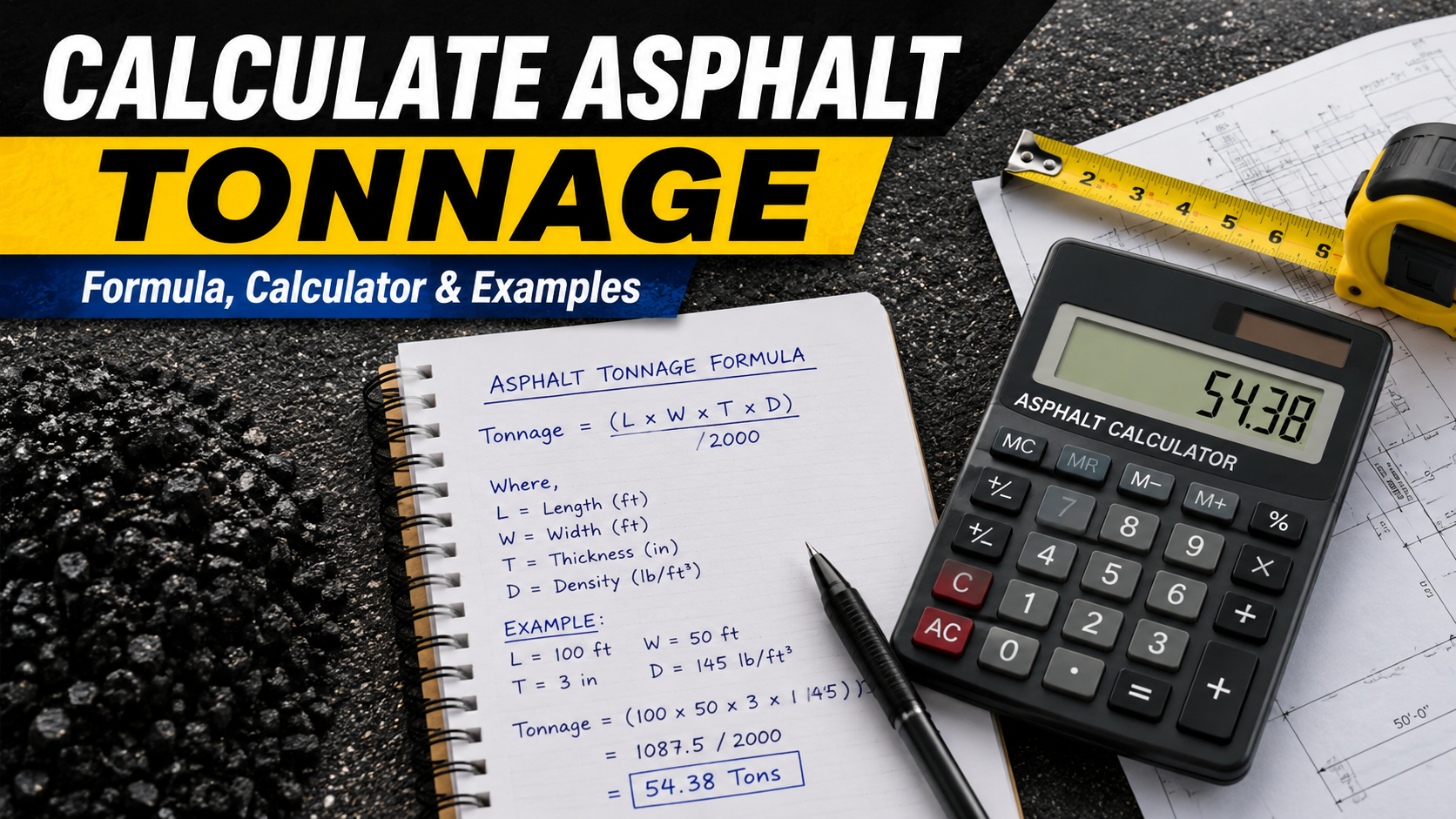
If you are planning a new driveway, parking lot, private road, or resurfacing project, one of the first things you need to know is how much asphalt to order. Ordering too little can delay the project, while ordering too much can increase costs and leave unused material behind.
That is why learning how to calculate asphalt tonnage is helpful before starting any paving work. Whether you are a homeowner, contractor, property manager, or DIY enthusiast, understanding the numbers can help you estimate material requirements with greater confidence.
Many people use an asphalt tonnage calculator, asphalt weight calculator, or asphalt calculator tons tool to get quick estimates. While these tools are useful, knowing the underlying formula helps you verify results and make adjustments based on project size, thickness, and asphalt type.
Asphalt Calculator is a powerful tool that helps you calculate tons, square feet, and total project cost accurately.
In this guide, you will learn the asphalt tonnage formula, understand how tonnage is calculated, and see practical examples for driveways, roads, and parking lots. You will also learn how tools such as an asphalt calculator, ton calculator, asphalt volume calculator, and asphalt paving calculator can simplify the process.
What Does Asphalt Tonnage Mean?
Asphalt tonnage refers to the total weight of asphalt material required for a paving project. Asphalt is generally sold and delivered by the ton, which is why contractors and suppliers commonly ask for tonnage estimates before providing pricing.
When people search for an asphalt ton calculator or an asphalt calculator square feet to tons, they are trying to convert a project’s dimensions into the amount of asphalt needed. Tonnage depends on three main factors: the surface area, the asphalt thickness, and the density of the asphalt mix.
For example, a small residential driveway may require only a few tons of material, while a large parking lot can require hundreds of tons. The larger the area and the thicker the asphalt layer, the greater the tonnage requirement.
Many online tools, including an asphalt square footage calculator, an asphalt calculator by square feet, and an asphalt calculator square feet, perform these calculations automatically. Even so, understanding the concept behind asphalt tonnage helps you verify estimates and avoid ordering mistakes.
Why Accurate Asphalt Tonnage Calculations Matter
Accurate tonnage calculations affect nearly every part of a paving project. Material costs, labor scheduling, delivery planning, and project timelines all depend on having a realistic estimate.
A difference of only a few tons can impact your budget. That is why contractors often double-check calculations using both an asphalt weight calculator and a manual formula before placing an order.
Knowing how to calculate asphalt tonnage can also help property owners compare contractor quotes and understand where material costs come from.
Cost Estimation Benefits
One of the biggest reasons to calculate tonnage correctly is cost control. Asphalt pricing is generally based on the number of tons required for a project. If your estimate is inaccurate, your budget may not reflect actual project expenses.
Many people use an asphalt calculator cost, asphalt calculator price, or asphalt cost calculator to estimate project expenses. These tools combine tonnage calculations with local material pricing to provide a rough cost estimate.
When the tonnage estimate is accurate, it becomes much easier to compare quotes from paving companies and understand how much of the total price is tied to materials.
For larger projects, even a small calculation error can result in hundreds or thousands of dollars in unexpected costs.
Material Planning Benefits
Accurate calculations also improve material planning. Contractors need enough asphalt on-site to complete paving without interruptions.
Running out of asphalt during installation can create delays and may require additional delivery charges. Ordering excessive material can also increase waste and disposal costs.
This is why many paving professionals rely on an asphalt yield calculator, hot mix asphalt calculator, and hot asphalt calculator when planning commercial and residential projects.
Having a reliable estimate helps crews schedule deliveries properly and keeps the paving process moving smoothly.
Information Needed to Calculate Asphalt Tonnage
Before using an asphalt tonnage calculator or applying the formula manually, you need a few measurements.
The first requirement is the length of the paved area. The second is the width. Multiplying these values provides the total surface area.
The next measurement is asphalt thickness. Thickness is commonly measured in inches for residential and commercial paving projects. Typical residential driveways often use 2 to 4 inches of compacted asphalt, while roads and parking lots may require different thicknesses depending on traffic loads.
The final factor is asphalt density. Most standard asphalt mixes have a density close to 145 pounds per cubic foot, although actual values can vary by mix design and supplier specifications.
If you are resurfacing an existing surface, you may also need tools such as a crushed asphalt calculator, asphalt milling calculator, or asphalt milling calculator to estimate recycled material quantities.
Once these measurements are available, you can move on to the formula.
Asphalt Tonnage Formula Explained
The asphalt tonnage formula converts project dimensions into tons of asphalt material.
The process begins by determining the total surface area. The area is then multiplied by the asphalt thickness to determine the volume. Finally, volume is converted into weight using asphalt density.
Most online tools use the same basic approach. Whether you use an asphalt calculator formula, an asphalt calculator tons calculator, or a professional estimating system, the underlying math remains very similar.
Understanding the formula helps you verify calculator results and make adjustments for unique project conditions.
Standard Asphalt Tonnage Formula
The most common formula used to calculate asphalt tonnage is shown below:
Tons of Asphalt = (Length × Width × Thickness × Density) ÷ 2000
Where:
- Length = feet
- Width = feet
- Thickness = feet
- Density = pounds per cubic foot
- 2000 = pounds in one ton
Using this formula provides a solid estimate for most residential and commercial paving projects.
These tools can help convert measurements into tons and estimate project costs without performing the calculations manually.
Many users compare results from an asphalt calculator, a square yards to tons calculator, an asphalt volume calculator, and an asphalt weight calculator to verify estimates before ordering materials. Some contractors also use an asphalt calculator app in the field to perform quick calculations while measuring a site.
How to Calculate Asphalt Tonnage Step by Step
Learning how to calculate asphalt tonnage is much easier when the process is broken into simple steps. While an asphalt tonnage calculator can provide instant results, understanding the calculation helps you verify estimates and make adjustments when project dimensions change.
Start by measuring the length and width of the area you plan to pave. Multiply those numbers together to find the total square footage. Once you have the area, determine the planned asphalt thickness. Thickness is usually measured in inches, so it must be converted into feet before applying the formula.
Next, calculate the asphalt volume by multiplying the area by the thickness. After finding the volume, multiply it by the asphalt density. Most paving estimates use a density of about 145 pounds per cubic foot unless a supplier provides a different value.
Finally, divide the total weight by 2,000 because one ton equals 2,000 pounds. The result is the estimated tonnage needed for the project.
Many property owners use an asphalt calculator by square feet or an asphalt calculator square feet tool because it performs these steps automatically. Even so, knowing the process helps you understand where the final number comes from.
For quick calculations, you can use our Asphalt Calculator for asphalt tons, cubic yards, square footage, and estimated project cost instantly
Asphalt Tons Per Square Foot Explained
One of the most common questions homeowners ask is how many tons of asphalt are needed per square foot. The answer depends on the thickness of the asphalt layer.
A thicker pavement structure requires more material per square foot than a thinner layer. This is why an estimate for a driveway with 2 inches of asphalt will differ from a parking lot designed with 4 inches of asphalt.
Understanding asphalt tons per square foot helps when comparing project sizes or estimating material requirements without performing a complete tonnage calculation every time.
The table below shows approximate asphalt requirements based on common paving thicknesses.
| Asphalt Thickness | Approximate Tons Per 100 Sq Ft |
| 2 Inches | 1.2 Tons |
| 3 Inches | 1.8 Tons |
| 4 Inches | 2.4 Tons |
| 5 Inches | 3.0 Tons |
| 6 Inches | 3.6 Tons |
These values are estimates and can vary based on asphalt density and compaction rates. Contractors often use similar reference charts when preparing preliminary bids.
When using an asphalt calculator square feet to tons, these conversions are calculated automatically behind the scenes.
Asphalt Density and Weight Factors
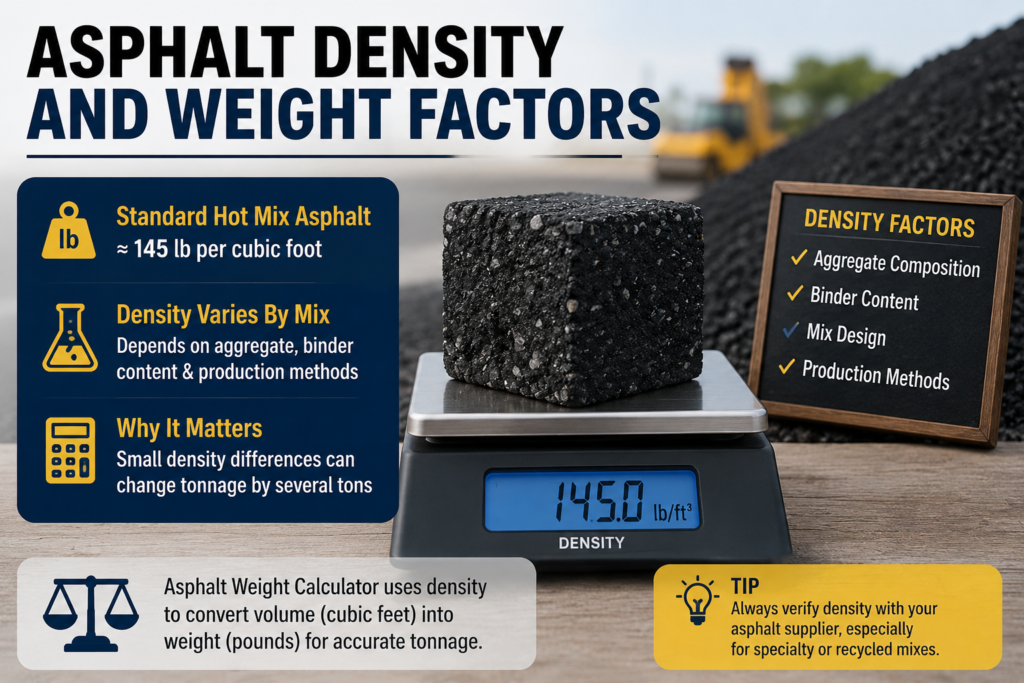
Density plays a major role in determining how much asphalt a project requires. Two projects with identical dimensions may require slightly different tonnage if the asphalt mixes have different densities.
Most standard hot mix asphalt products weigh around 145 pounds per cubic foot. Some specialty mixes may weigh more or less depending on aggregate composition, binder content, and production methods.
This is why professional estimators often verify density values before finalizing material orders. A small density difference across a large commercial project can change the required tonnage by several tons.
An asphalt weight calculator uses density values to convert volume into weight. If the density entered into the calculator is incorrect, the final estimate may also be inaccurate.
This factor becomes even more important when working with recycled materials. Projects using reclaimed asphalt may require a crushed asphalt calculator, an asphalt milling calculator, or an asphalt milling calculator because recycled materials can have different characteristics than newly produced asphalt.
For the most reliable estimate, always check with your asphalt supplier if you are working with a specialty mix.
Asphalt Thickness Conversion Chart
Thickness is one of the most common sources of mistakes during asphalt calculations. Many project dimensions are measured in feet, while asphalt thickness is usually measured in inches.
Before applying the asphalt tonnage formula, thickness should be converted into feet.
The chart below provides quick conversions that are commonly used during paving estimates.
| Thickness (Inches) | Thickness (Feet) |
| 1 Inch | 0.083 Feet |
| 2 Inches | 0.167 Feet |
| 3 Inches | 0.250 Feet |
| 4 Inches | 0.333 Feet |
| 5 Inches | 0.417 Feet |
| 6 Inches | 0.500 Feet |
Many people make the mistake of entering inches directly into a formula that requires feet. This can create major errors in tonnage calculations.
An asphalt calculator formula tool automatically converts these measurements, reducing the risk of mistakes.
Asphalt Tonnage Calculation Example for a Driveway
A residential driveway is one of the most common projects where people need to calculate asphalt tonnage.
Imagine a driveway that is 20 feet wide and 50 feet long. The total area would be:
20 × 50 = 1,000 square feet
Assume the asphalt thickness will be 3 inches. Three inches convert to 0.25 feet.
The asphalt volume becomes:
1,000 × 0.25 = 250 cubic feet
Using a density of 145 pounds per cubic foot:
250 × 145 = 36,250 pounds
Converting pounds to tons:
36,250 ÷ 2,000 = 18.13 tons
The driveway would require approximately 18 tons of asphalt.
A homeowner using an asphalt calculator tons tool or an asphalt ton calculator should expect a result close to this estimate.
Read our Ultimate Asphalt Driveway Thickness Guide to avoid costly mistakes and choose the right pavement thickness for your project.
Asphalt Tonnage Calculation Example for a Residential Road
Road construction projects generally involve larger areas and higher material requirements.
Suppose a residential road section measures 24 feet wide and 500 feet long.
The total area would be:
24 × 500 = 12,000 square feet
If the asphalt thickness is 4 inches, the thickness in feet becomes 0.333.
The asphalt volume equals:
12,000 × 0.333 = 3,996 cubic feet
Applying a density of 145 pounds per cubic foot:
3,996 × 145 = 579,420 pounds
Converting to tons:
579,420 ÷ 2,000 = 289.71 tons
This road section would require approximately 290 tons of asphalt.
For larger projects, contractors often use an asphalt paving calculator, hot mix asphalt calculator, or asphalt calculator tons calculator because manual calculations become time-consuming.
Asphalt Tonnage Calculation Example for a Parking Lot
Parking lots often require careful tonnage estimates because even small calculation errors can affect material costs.
Consider a parking lot measuring 150 feet by 200 feet.
The total area is:
150 × 200 = 30,000 square feet
Assume a pavement thickness of 4 inches, which equals 0.333 feet.
The asphalt volume becomes:
30,000 × 0.333 = 9,990 cubic feet
Using standard asphalt density:
9,990 × 145 = 1,448,550 pounds
Converting pounds into tons:
1,448,550 ÷ 2,000 = 724.28 tons
The parking lot would require approximately 724 tons of asphalt.
Projects of this size often use an asphalt volume calculator, asphalt yield calculator, or asphalt calculator ton calculator to verify quantities before ordering materials.
Because parking lot projects can involve substantial material costs, many contractors also use an asphalt calculator cost tool and an asphalt calculator price estimator to develop accurate project budgets.
Asphalt Weight Calculator vs Manual Formula
Both manual calculations and online tools can help you calculate asphalt tonnage, but each method has its own advantages.
A manual calculation gives you a better understanding of how asphalt quantities are determined. When you use the formula yourself, you can see how changes in thickness, area, or density affect the final tonnage. This is useful when reviewing contractor estimates or planning multiple project options.
An asphalt weight calculator saves time and reduces the chance of mathematical errors. Instead of performing several calculations, you simply enter the project dimensions and receive an estimate within seconds. This approach is especially helpful for larger projects where calculations become more complex.
Many contractors use both methods. They may start with an asphalt tonnage calculator or a san phalt calculator tons calculator and then compare the result against a manual estimate before ordering material.
For most homeowners, an online calculator is the easiest option. For contractors and project managers, understanding the formula adds an extra level of confidence when reviewing material requirements.
When to Use an Asphalt Weight Calculator
An asphalt weight calculator is useful whenever you need a quick estimate without working through the formula manually.
Homeowners often use a calculator when planning a driveway replacement, while contractors rely on calculators when preparing bids and project proposals. Property managers may also use calculators to estimate material quantities before requesting quotes from paving companies.
A calculator becomes even more valuable when a project includes multiple paving areas. Instead of calculating each section separately by hand, measurements can be entered directly into the tool for faster results.
Many online tools are designed for specific situations. An asphalt paving calculator may focus on new pavement installations, while an asphalt milling calculator can help estimate reclaimed asphalt quantities. Projects using recycled material may benefit from a crushed asphalt calculator or an asphalt millings calculator.
If your goal is simply to determine how many tons of asphalt are needed, an asphalt calculator tons tool can provide a fast and practical estimate.
Common Asphalt Measurement Units Explained
Asphalt calculations involve several different units of measurement. Understanding these units makes it easier to use calculators correctly and avoid mistakes when estimating material quantities.
The most common measurements include square feet, square yards, inches, feet, pounds, and tons. Each measurement plays a different role in the calculation process.
Area measurements determine the size of the surface being paved, while thickness measurements determine how deep the asphalt layer will be. Weight measurements convert the final volume into tons, which is how asphalt is usually sold.
Many people become confused when switching between units, which is why online tools such as an asphalt square footage calculator and an asphalt calculator square yards to tons calculator are so popular.
Square Feet vs Square Yards
Square feet and square yards are both used to measure paving areas. Residential projects are often measured in square feet, while larger commercial projects may be discussed in square yards.
One square yard equals nine square feet.
For example, a 900-square-foot driveway is equal to 100 square yards.
Contractors may use either measurement depending on local practices and project type. If a calculator requests square yards but your measurements are in square feet, a simple conversion can solve the problem.
Many online tools automatically convert measurements, making it easier to switch between units without additional calculations.
Inches vs Feet
Thickness measurements create another common source of confusion.
Most paving projects describe asphalt thickness in inches. The calculation formula, however, typically requires thickness in feet.
Before applying the formula, inches must be converted into feet. For example, 3 inches becomes 0.25 feet, while 4 inches becomes approximately 0.333 feet.
Failing to make this conversion can lead to major errors in tonnage estimates.
An asphalt calculator formula tool handles these conversions automatically, which helps prevent mistakes during the estimating process.
How Asphalt Thickness Affects Total Tons Required
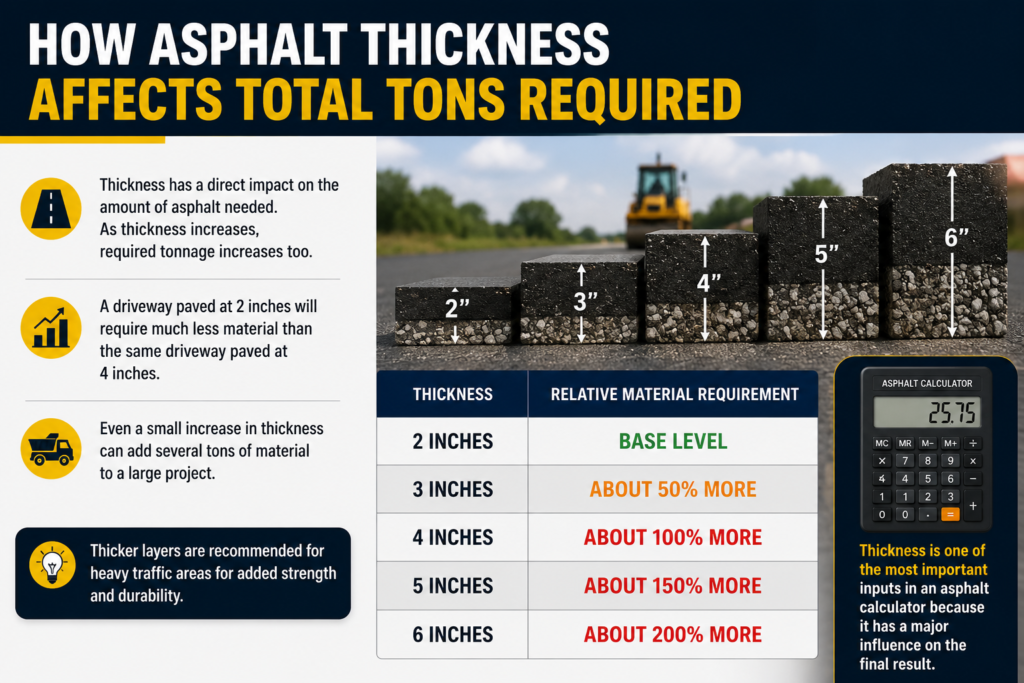
Thickness has a direct impact on the amount of asphalt needed for a project. As thickness increases, the required tonnage increases as well.
A driveway paved at 2 inches will require much less material than the same driveway paved at 4 inches. Although the area remains unchanged, the volume of asphalt doubles.
This relationship is one reason contractors pay close attention to project specifications. Even a small increase in thickness can add several tons of material to a large project.
The chart below shows how tonnage changes as asphalt thickness increases.
| Thickness | Relative Material Requirement |
| 2 Inches | Base Level |
| 3 Inches | About 50% More |
| 4 Inches | About 100% More |
| 5 Inches | About 150% More |
| 6 Inches | About 200% More |
For heavy traffic areas, thicker asphalt layers are often recommended because they provide additional strength and durability. Residential driveways generally require less thickness than commercial parking lots or roads.
When using an asphalt calculator, thickness is one of the most important inputs because it has a major influence on the final result.
Asphalt Tonnage Estimates by Project Size
Different project sizes require different amounts of asphalt. A small residential driveway may need fewer than 20 tons, while large commercial developments may require hundreds of tons.
Project size is usually determined by the total square footage of the paving area. Once the area is known, thickness and density can be used to estimate tonnage.
The table below provides general tonnage ranges for common project categories.
| Project Type | Typical Tonnage Range |
| Small Driveway | 10–20 Tons |
| Large Driveway | 20–40 Tons |
| Private Road | 100–300 Tons |
| Commercial Parking Lot | 200–800 Tons |
| Industrial Facility | 500+ Tons |
Actual requirements depend on thickness, design specifications, and asphalt density.
These estimates can be used as a starting point before applying the full asphalt tonnage formula.
Average Asphalt Tons Needed for Common Driveway Sizes
Driveways vary greatly in size, but many residential projects fall within a predictable range.
The following estimates assume a typical asphalt thickness used for residential paving.
| Driveway Size | Approximate Tons Required |
| 10 × 20 Feet | 4–6 Tons |
| 12 × 40 Feet | 8–10 Tons |
| 20 × 40 Feet | 14–16 Tons |
| 20 × 50 Feet | 18–20 Tons |
| 24 × 60 Feet | 25–30 Tons |
These values provide a useful starting point when budgeting for a driveway installation or replacement.
Homeowners often use an asphalt calculator by square feet, an asphalt calculator square feet, or an asphalt square footage calculator to obtain more precise estimates based on their specific dimensions.
Average Asphalt Tons Needed for Small and Large Parking Lots
Parking lots require much larger quantities of asphalt than residential driveways. The final tonnage depends on the lot dimensions, pavement thickness, and expected traffic loads.
Small retail parking lots may require a few hundred tons of asphalt, while larger commercial facilities can require several hundred additional tons.
The table below shows common parking lot tonnage ranges.
| Parking Lot Size | Approximate Tons Required |
| Small Lot | 100–250 Tons |
| Medium Lot | 250–500 Tons |
| Large Lot | 500–800 Tons |
| Very Large Lot | 800+ Tons |
Commercial contractors often combine an asphalt volume calculator, hot asphalt calculator, and asphalt yield calculator when preparing estimates for projects of this size.
Because material costs can be substantial, many companies also use an asphalt calculator cost tool and an asphalt calculator price estimator to evaluate project budgets before construction begins.
For larger commercial projects, calculating both tonnage and expected costs before ordering materials can help improve planning and reduce unnecessary expenses.
Asphalt Quantity Estimation Mistakes to Avoid
Many asphalt projects run into problems because of simple calculation mistakes. Even a small error can affect material costs, delivery schedules, and project timelines.
One common mistake is measuring the paving area incorrectly. If the length or width measurements are wrong, every calculation that follows will also be incorrect. Taking multiple measurements and verifying dimensions before ordering material can help avoid this issue.
Another frequent mistake involves thickness conversions. Many people enter thickness values in inches when the formula requires feet. This can create large differences in the final tonnage estimate.
Some property owners also forget to account for waste, compaction, and irregular project layouts. Areas with curves, additional parking spaces, or unique shapes may require slightly more asphalt than a basic rectangular estimate suggests.
Using an asphalt tonnage calculator, asphalt calculator tons, or asphalt weight calculator can help reduce these errors, but measurements should still be checked carefully before placing an order.
How Contractors Estimate Asphalt Tonnage
Professional paving contractors follow a structured process when estimating asphalt quantities.
The first step usually involves measuring the site and calculating the total square footage. Contractors then review project specifications to determine the required asphalt thickness based on expected traffic loads and local conditions.
After establishing the area and thickness, they apply the asphalt tonnage formula or use specialized estimating software. Many contractors also compare results from an asphalt paving calculator, asphalt volume calculator, and asphalt calculator tons calculator to confirm material requirements.
For larger commercial projects, contractors may include an additional material allowance to account for waste, grading adjustments, and field conditions. This extra planning helps prevent delays caused by material shortages.
Experienced estimators also consider the type of asphalt mix being used because different mixes can affect density and final tonnage requirements.
Factors That Can Increase Asphalt Requirements
Several factors can increase the amount of asphalt needed for a project.
The most obvious factor is thickness. A thicker asphalt layer requires more material, which increases total tonnage. Areas exposed to heavy vehicle traffic often require greater thickness than standard residential driveways.
Surface conditions can also affect asphalt requirements. Existing pavement damage, poor base conditions, and uneven grades may require additional material to achieve a smooth finished surface.
Project design is another factor. Parking lots with islands, curved sections, loading zones, and access lanes often require more detailed calculations than simple rectangular areas.
Climate considerations may also influence pavement design. In some locations, engineers recommend thicker pavement structures to improve long-term durability.
When estimating material quantities, it is always a good idea to verify calculations using both an asphalt calculator and a ton calculator and the standard formula.
Asphalt Tonnage Calculation Quick Reference Table
After learning how to calculate asphalt tonnage, many property owners prefer using a quick reference chart for rough estimates.
The table below provides approximate asphalt requirements for common surface areas using standard residential paving thicknesses.
| Surface Area (Sq Ft) | Approximate Asphalt Tons |
| 500 | 9 Tons |
| 1,000 | 18 Tons |
| 1,500 | 27 Tons |
| 2,000 | 36 Tons |
| 3,000 | 54 Tons |
| 5,000 | 90 Tons |
These figures are intended for planning purposes and may vary based on actual asphalt density and pavement thickness.
For more precise estimates, use our calculator tools:
For additional insights on driveway paving costs, read our Asphalt Driveway Cost Guide to understand the factors that affect pricing and project estimates.
Benefits of Using an Online Asphalt Weight Calculator
An online asphalt weight calculator can simplify the estimating process and reduce the chance of errors.
Instead of manually converting measurements and applying formulas, users can enter project dimensions and receive results almost instantly. This saves time and makes it easier to compare different project options.
Many calculators also include features that go beyond tonnage estimation. Some tools provide cost estimates, while others help convert square feet into tons or calculate project volume.
Depending on your needs, you may encounter tools such as an asphalt calculator square feet to tons, an asphalt square yards to tons calculator, a hot mix asphalt calculator, an asphalt yield calculator, or a hot asphalt calculator.
Each tool serves a slightly different purpose, but all are designed to help users estimate asphalt quantities more efficiently.
Whether you are planning a small driveway or a large commercial parking lot, an online calculator can provide a fast starting point for project planning.
Is there a difference between an asphalt tonnage calculator and an asphalt weight calculator?
Both tools are very similar, but they focus on different outputs. An asphalt tonnage calculator usually shows the total tons of asphalt needed, while an asphalt weight calculator may display the weight in pounds, tons, or other units. Most online calculators can provide both results using the same project measurements.
Frequently Asked Questions (FAQs)
How accurate is an asphalt calculator for estimating material needs?
An asphalt calculator can provide a reliable estimate when the correct length, width, thickness, and density values are entered. The final amount ordered may still vary slightly because of compaction, site conditions, and the type of asphalt mix being used.
Can I use an asphalt calculator for a resurfacing project?
Yes. An asphalt calculator can be used for new installations and resurfacing projects. You simply enter the dimensions of the area being resurfaced and the planned overlay thickness to estimate the required tonnage.
What is the best asphalt thickness for a residential driveway?
Most residential driveways use between 2 and 4 inches of compacted asphalt. A driveway that supports only passenger vehicles may require less thickness than a driveway used by delivery trucks, RVs, or heavier equipment.
How many square feet does one ton of asphalt cover?
The coverage area depends on asphalt thickness. At a thickness of about 2 inches, one ton of asphalt typically covers around 80 square feet. As thickness increases, the coverage area per ton decreases.
Why do contractors order extra asphalt material?
Contractors often order a small amount of extra asphalt to account for waste, uneven surfaces, compaction, and measurement differences. This helps prevent delays that could occur if the project runs short on material.
Can weather affect asphalt tonnage requirements?
Weather does not directly change the tonnage calculation, but climate conditions can influence pavement design. Areas with heavy traffic, freeze-thaw cycles, or extreme temperatures may require thicker asphalt layers, which increases the total tons needed.
What is the difference between hot mix asphalt and recycled asphalt calculations?
The calculation method remains largely the same, but density values may differ. When working with reclaimed materials, many contractors use a hot mix asphalt calculator, crushed asphalt calculator, or asphalt millings calculator to get a more accurate estimate.
Should I calculate asphalt by square feet or square yards?
Either method can be used as long as the measurements are converted correctly. Residential projects are commonly measured in square feet, while larger commercial projects may be estimated in square yards. Many online calculators support both measurement types.
How do I estimate asphalt costs after calculating tonnage?
Once you know the required tonnage, you can multiply the number of tons by the local asphalt price per ton. Many people use an asphalt cost calculator or asphalt calculator price tool because these calculators combine tonnage estimates with material pricing to provide a rough project budget.
Final Thoughts on How to Calculate Asphalt Tonnage
Learning how to calculate asphalt tonnage can help you estimate material requirements, compare contractor quotes, and plan paving projects more effectively. Whether you are installing a driveway, resurfacing a private road, or building a parking lot, accurate calculations can reduce waste and improve budgeting.
The basic process involves measuring the paving area, determining asphalt thickness, applying the asphalt tonnage formula, and converting the result into tons. While manual calculations are useful for understanding the process, online tools can save time and simplify project planning.
Resources such as an asphalt tonnage calculator, asphalt weight calculator, asphalt calculator tons, asphalt volume calculator, and asphalt paving calculator make it easier to estimate quantities for projects of all sizes.
Before ordering asphalt, double-check your measurements, verify thickness requirements, and compare calculator results against the formula whenever possible. Taking a few extra minutes during the planning stage can help avoid costly material shortages and provide a more accurate estimate for your project.