
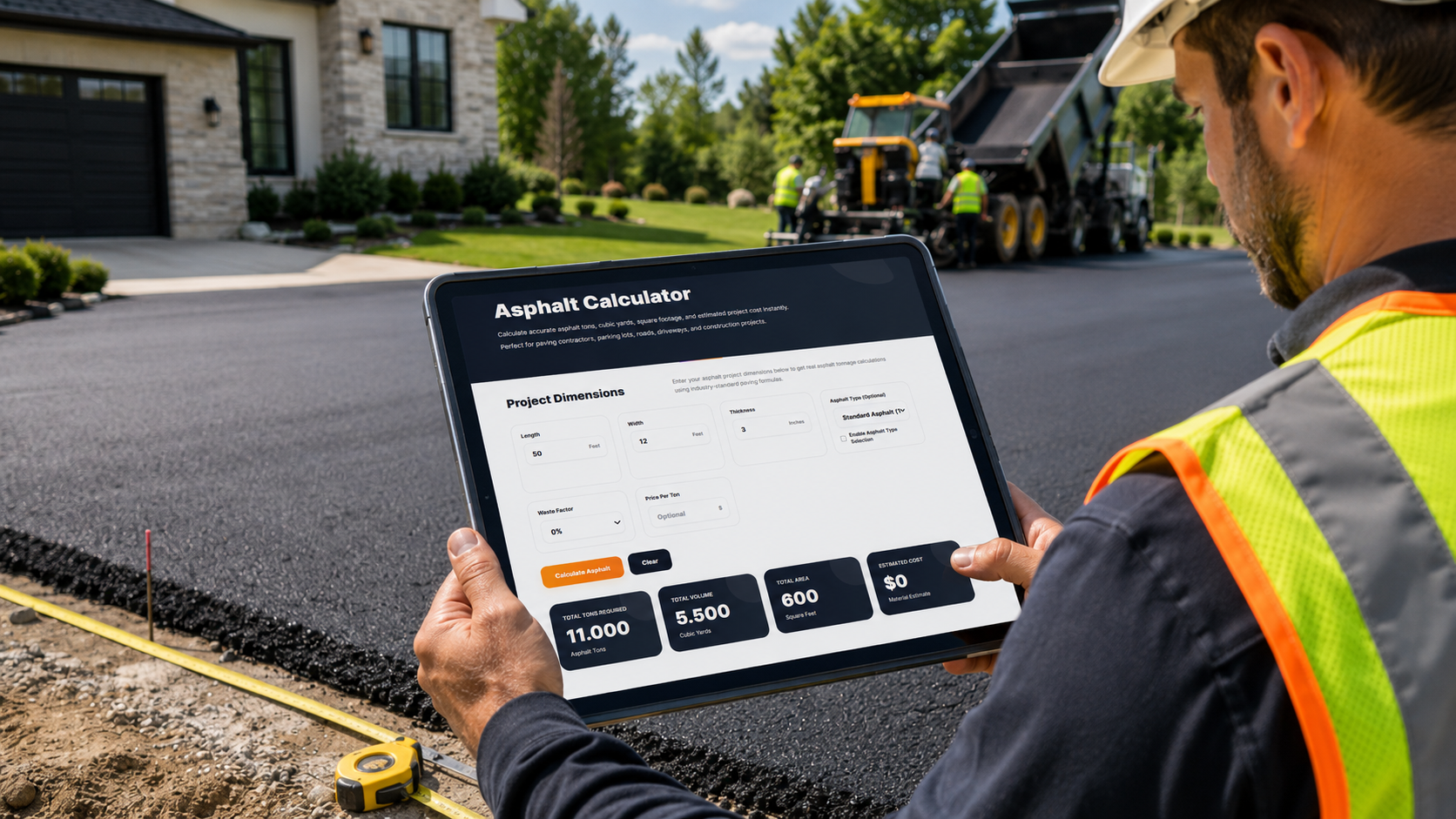
Planning an asphalt project without a clear quantity can lead to short orders, wasted material, and a higher bill than expected. Asphalt Calculator: Instantly Estimate Tons, Cost & Quantity is made for people who want to know how much asphalt they need before they buy, call a supplier, or compare contractor quotes. This guide explains how an asphalt calculator works, how to estimate tons from square feet, how thickness and density change the final amount, how to calculate cost, and how to avoid common mistakes before paving a driveway, parking lot, road, or repair area.
Asphalt Calculator
Use our Asphalt Calculator to instantly estimate tons, cubic yards, and project costs.
An asphalt calculator helps you turn basic project measurements into a useful material estimate. Instead of guessing how many tons to order, you can enter the length, width, thickness, density, and price per ton to get a clearer number before work begins.
Most asphalt is ordered by weight, not just by surface size. That is why square feet alone are not enough. A 500-square-foot area at 2 inches thick needs far less asphalt than the same area at 4 inches thick.
A good asphalt paving calculator can show your area, volume, tons, and estimated cost in one place. This makes it easier to plan a driveway, parking lot, private road, or patch repair without starting with rough guesses.
Many calculators use 145 pounds per cubic foot as a default asphalt density. Vulcan Materials uses a default density of 145 lbs per cubic foot, while also saying actual density can change by mix design.
What This Asphalt Calculator Helps You Estimate
This asphalt calculator helps you estimate the amount of asphalt needed for a paving job. It is useful when you know the length, width, and planned thickness of the area but do not know how those numbers convert into tons.
You can use it as an asphalt square footage calculator when your first goal is to measure the paved area. You can also use it as an asphalt volume calculator when you need cubic feet or cubic yards. When the calculator converts that volume into weight, it works like an asphalt weight calculator.
The calculator can help you estimate driveway material, parking lot material, road resurfacing material, patch repair material, and hot mix material. It can also help you compare how the total cost changes when you use different thicknesses or prices per ton.
For many homeowners and small contractors, the main question is simple: “How much asphalt should I order?” This tool gives you a starting number so you can speak with a supplier or contractor with more confidence.
How Much Asphalt Do I Need? Quick Answer
To answer how much asphalt I need, you need three main inputs: area, thickness, and density. Area tells you how wide and long the project is. Thickness tells you how deep the asphalt layer will be. Density helps convert volume into weight.
The simple formula is length times width times thickness times density. If you measure length and width in feet, you must convert thickness from inches into feet before multiplying.
For example, if a driveway is 40 feet long, 12 feet wide, and 3 inches thick, the area is 480 square feet. Since 3 inches is 0.25 feet, the volume is 120 cubic feet. Using 145 pounds per cubic foot, the asphalt weighs 17,400 pounds. Since 2,000 pounds equals 1 U.S. ton, the project needs about 8.7 tons before adding any waste allowance.
A quick estimate works best when the project shape is simple. If the area has curves, side pads, uneven edges, or more than one thickness, it is better to divide the job into smaller sections and add the results together.
| Project Input | Example Value | Result |
| Length | 40 ft | — |
| Width | 12 ft | 480 sq ft area |
| Thickness | 3 in | 0.25 ft |
| Volume | 480 × 0.25 | 120 cu ft |
| Weight | 120 × 145 | 17,400 lb |
| Tons | 17,400 ÷ 2,000 | 8.7 tons |
This is why an asphalt calculator square feet to tons tool is helpful. It turns a surface measurement into a buying estimate.
How to Use the Asphalt Calculator Step by Step
The best way to use an asphalt calculator is to start with clean measurements. Measure the project area carefully, choose the planned thickness, add a realistic density, and then enter the cost per ton if you want a price estimate.
Do not rely on a quick visual guess. A few feet of missed width or a wrong thickness entry can change the final tonnage. This matters even more when the project is large, such as a parking lot or private road.
If the area has more than one section, measure each part on its own. A driveway with a parking pad should not always be entered as one rectangle. A parking lot with drive lanes and loading zones may need different thicknesses in different areas.
A free asphalt calculator square feet tool is most useful when it lets you enter length, width, thickness, density, and cost. These fields give a better estimate than a calculator that only asks for square footage.
Enter Length, Width, and Thickness
Start by entering the length and width of the area. These two measurements give you the square footage. For a rectangular area, square footage is length multiplied by width.
Thickness is the next key input. Asphalt thickness is often measured in inches, but most formulas need the thickness in feet. To convert inches into feet, divide the number of inches by 12.
For example, 2 inches equals 0.167 feet. Three inches equals 0.25 feet. Four inches equals 0.333 feet. This small conversion has a large effect on the final number.
An asphalt calculator by square feet can be helpful when you already know the total square footage of your project. In that case, you can enter the square feet directly and then add the thickness to calculate volume and tons.
| Thickness in Inches | Thickness in Feet |
| 2 in | 0.167 ft |
| 3 in | 0.25 ft |
| 4 in | 0.333 ft |
| 6 in | 0.5 ft |
This table helps prevent one of the most common mistakes: entering inches as feet. If you enter 3 feet instead of 3 inches, the estimate will be far too high.
Add Asphalt Density and Cost Per Ton
After size and thickness, add the asphalt density. Density tells you how much the asphalt weighs for each cubic foot of material.
Many U.S. asphalt calculators use about 145 pounds per cubic foot as a common default for hot mix asphalt. This is a practical planning number, but the real density can change by mix type, aggregate, binder, air voids, and supplier.
If your supplier gives you a mixed density, use that number. If not, a default value can help you create a planning estimate. A hot mix asphalt calculator or hot asphalt calculator often includes a default density field because hot mix is commonly ordered by ton.
Cost per ton is optional, but it helps you estimate the material budget. In 2026, Angi lists replacement asphalt driveway costs at about $8 to $15 per square foot, including removal, materials, and labor. Material-only pricing will vary by local supplier, project size, delivery distance, and mix type.
Review Tons, Cubic Yards, and Total Project Cost
Once the calculator has your measurements, density, and price, review the results before ordering. Look at the square footage, cubic feet, cubic yards, tons, and total cost.
Square footage tells you the surface size. Cubic feet and cubic yards show the asphalt volume. Tons show the estimated buying amount. Cost shows the rough material budget based on your price per ton.
If the result seems too high or too low, check your thickness first. Then check whether you entered feet, inches, yards, or square feet correctly.
This is also where an asphalt calculator tons result becomes useful. It gives you the number most suppliers need when you ask for a quote.
Asphalt Quantity Calculator Formula
An asphalt quantity calculator uses a simple path. It starts with area, changes area into volume, and then changes volume into tons.
This method works because asphalt is not only a flat surface. It has length, width, and depth. If you ignore thickness, your estimate will be incomplete.
The full estimate depends on the unit you use. In the United States, many homeowners measure in feet and inches, while suppliers often sell asphalt by the ton. A calculator connects those units so you do not need to convert everything by hand.
The main formula is:
Length × Width × Thickness × Density ÷ 2,000 = Tons
If thickness is in inches, divide it by 12 before using it in the formula.
Area Formula
The area formula is length multiplied by width. If the project is measured in feet, the result is square feet.
For a driveway that is 50 feet long and 12 feet wide, the area is 600 square feet. This is the starting point for the whole estimate.
If the project shape is not a clean rectangle, split it into smaller rectangles. Calculate each section and add them together. This method is better for driveways with turnarounds, parking pads, or wide entrances.
A basic asphalt calculator square feet input works well when your project is one simple shape. For mixed shapes, section-by-section measuring gives a cleaner result.
Volume Formula
The volume formula is area multiplied by thickness. If the area is in square feet and the thickness is in feet, the result is cubic feet.
For example, a 600-square-foot driveway at 3 inches thick uses a thickness of 0.25 feet. The volume is 600 multiplied by 0.25, which equals 150 cubic feet.
To convert cubic feet into cubic yards, divide by 27. This is because one cubic yard contains 27 cubic feet.
An asphalt volume calculator does this step for you. It saves time and helps reduce unit mistakes.
| Area | Thickness | Volume in Cubic Feet | Volume in Cubic Yards |
| 600 sq ft | 2 in | 100 cu ft | 3.70 cu yd |
| 600 sq ft | 3 in | 150 cu ft | 5.56 cu yd |
| 600 sq ft | 4 in | 200 cu ft | 7.41 cu yd |
This table shows why thickness changes the final order so much. The same 600-square-foot area needs twice as much asphalt at 4 inches as it does at 2 inches.
Tons Formula
The tons formula changes volume into weight. The formula is cubic feet multiplied by density, then divided by 2,000.
If the volume is 150 cubic feet and the density is 145 pounds per cubic foot, the weight is 21,750 pounds. Dividing by 2,000 gives 10.875 tons.
This is where an asphalt ton calculator or asphalt calculator ton tool saves time. You do not have to do every conversion by hand.
You can also estimate tons from cubic yards. At 145 pounds per cubic foot, one cubic yard weighs about 3,915 pounds, or about 1.96 tons.
That means one cubic yard of asphalt is close to 2 tons at this density.
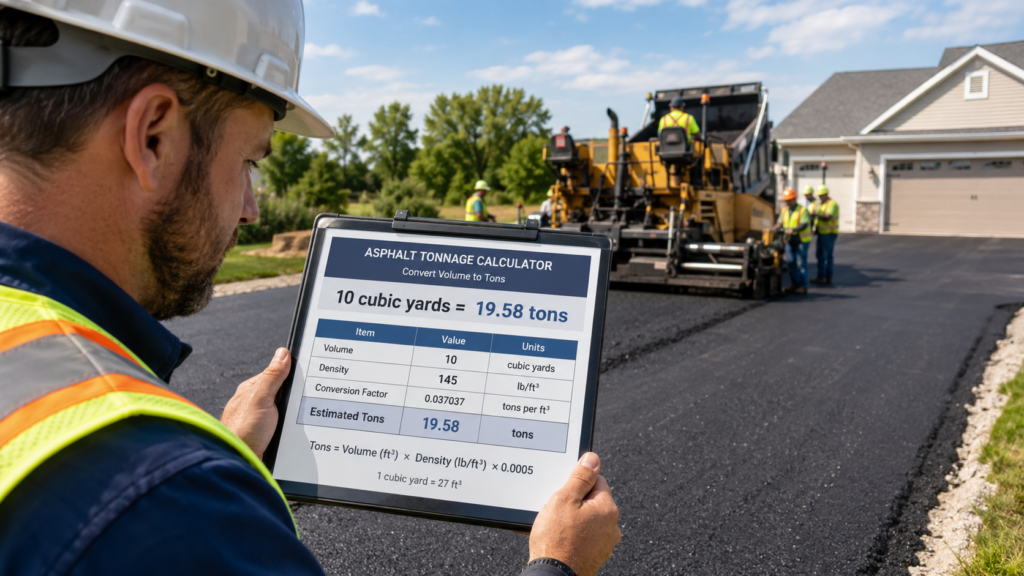
Asphalt Tonnage Calculator: Convert Volume to Tons
An asphalt tonnage calculator helps convert volume into tons. This matters because homeowners often measure a project in square feet, while suppliers usually sell asphalt in tons.
The calculator first finds the volume, then applies the density. Without density, the calculator cannot give a weight estimate.
For example, 10 cubic yards of asphalt at 145 pounds per cubic foot weighs about 19.6 tons. If the density is higher, the tonnage rises. If the density is lower, the tonnage drops.
This is why the same project can show slightly different totals on different calculators. One calculator may use 145 pounds per cubic foot, while another may use a different value.
| Asphalt Volume | Estimated Weight at 145 lb/ft³ |
| 1 cubic foot | 145 lb |
| 1 cubic yard | 3,915 lb |
| 1 cubic yard | 1.96 tons |
| 5 cubic yards | 9.79 tons |
| 10 cubic yards | 19.58 tons |
This table gives a simple way to understand how volume becomes weight. For ordering, ask your local supplier what density they use for your selected mix.
Asphalt Tons Calculator: Tons, Cubic Yards, and Truckloads
An asphalt tons calculator helps you see the project from a buying and delivery angle. Tons tell you how much asphalt to buy. Cubic yards show the volume. Truckloads help you think about delivery.
Truck capacity changes by truck size, road rules, supplier, and job access. A small repair may only need a few tons. A parking lot may need many truckloads.
If your estimate is 12 tons, ask the supplier whether that can come in one truck. If your estimate is 60 tons, ask how many deliveries are needed and how the timing will work.
Hot mix asphalt should be placed while it is still workable. For that reason, delivery timing matters as much as the number of tons.
| Estimated Tons | Approx. Cubic Yards at 145 lb/ft³ | Common Use |
| 5 tons | 2.55 cu yd | Small repair or short driveway section |
| 10 tons | 5.10 cu yd | Medium driveway |
| 20 tons | 10.20 cu yd | Larger driveway or small lot |
| 50 tons | 25.53 cu yd | Parking lot section |
This table is a planning guide. Always check delivery limits and load rules with the supplier before ordering.
Asphalt Density: Why It Changes Your Final Quantity
Asphalt density changes the final tonnage because density controls how heavy the mix is. Two asphalt mixes can cover the same volume but weigh different amounts.
Density can change because of aggregate size, binder content, recycled material, air voids, and mix design. This is why professional calculators often allow density edits.
If one calculator uses 138 pounds per cubic foot and another uses 150 pounds per cubic foot, the final ton estimate will not match. The area and thickness may be the same, but the weight will be different.
This is one reason an asphalt weight calculator should not be treated as a final supplier quote. It gives a strong estimate, but the supplier’s mix details should guide the final order.
| Volume | Density | Estimated Tons |
| 100 cu ft | 138 lb/ft³ | 6.90 tons |
| 100 cu ft | 145 lb/ft³ | 7.25 tons |
| 100 cu ft | 150 lb/ft³ | 7.50 tons |
On a small driveway, this difference may be manageable. On a large parking lot, it can add several tons to the order.
Recommended Asphalt Thickness by Project Type
Asphalt thickness should match how the surface will be used. A light driveway for passenger cars does not need the same design as a commercial entrance used by delivery trucks.
Thickness affects the amount of asphalt, the cost, and the strength of the paved surface. More thickness means more material. It also means a higher cost, but it may be needed for heavier use.
A calculator can help you compare thickness options before you speak with a contractor. For example, testing 2 inches, 3 inches, and 4 inches can show how the total tons and cost change.
| Project Type | Common Planning Thickness | Typical Use |
| Light driveway | 2–3 in | Cars and light use |
| Standard residential driveway | 3–4 in | Daily home use |
| Parking lot | 3–5 in | Cars and light commercial traffic |
| Heavy-duty parking area | 5–7 in | Trucks and delivery vehicles |
| Road or industrial area | 4–8+ in | Repeated heavy traffic |
These are planning ranges. Soil, base material, drainage, climate, and traffic load can change the right thickness.
Driveways
A residential driveway often needs enough asphalt to handle daily vehicle use without cracking early. Many driveway projects use a thickness of around 2 to 4 inches, depending on the base and vehicle load.
If the driveway only handles cars, a lighter thickness may be enough. If it handles trucks, trailers, RVs, or frequent turning, it may need more asphalt and a stronger base.
The base layer also matters. A poor base can damage the asphalt even when the surface layer is thick. That is why the calculator should help with material quantity, while a contractor checks the site conditions.
For homeowners, the best use of an asphalt calculator is to compare different thickness options before getting quotes.
Parking Lots
Parking lots usually need more planning than driveways because traffic patterns vary across the surface. Parking spaces, drive lanes, entrances, and loading areas may not all need the same thickness.
A simple parking lot may use one thickness across the full area. A busier lot may need heavier pavement in the drive lanes and entrance areas.
When you use an asphalt square yards to tons calculator, make sure the area measurement matches the unit required by the tool. If the calculator asks for square feet, do not enter square yards without converting.
Parking lots also need good drainage. Standing water can shorten pavement life and lead to cracks, potholes, and base damage.
Roads and Heavy-Traffic Areas
Roads and heavy-traffic areas need a stronger plan because they carry repeated loads. A few heavy trucks can place more stress on asphalt than many passenger cars.
For these projects, an asphalt calculator should be used for quantity planning, not final pavement design. A paving professional may need to check the base, soil, drainage, traffic load, and local rules.
Road projects may also require multiple asphalt layers, called lifts. Each lift may need a separate quantity estimate.
Large jobs also need careful delivery timing. If hundreds of tons are needed, the crew must plan truck arrivals, paving speed, rolling, and temperature control.
Asphalt Calculator for Driveways
A driveway is one of the most common reasons people search for an asphalt calculator. Homeowners want to know how many tons they need and what the project may cost before speaking with contractors.
Start by measuring the full driveway. Include the main lane, apron, side parking pad, and turnaround area if they will be paved.
A driveway that looks simple may still have extra square footage near the street or garage. Missing these areas can lead to a short order.
For example, a 50-foot by 12-foot driveway at 3 inches thick equals 600 square feet and 150 cubic feet. At 145 pounds per cubic foot, it needs about 10.88 tons before waste. With a 5% allowance, the estimate is about 11.42 tons.
| Driveway Input | Example Value |
| Length | 50 ft |
| Width | 12 ft |
| Thickness | 3 in |
| Area | 600 sq ft |
| Volume | 150 cu ft |
| Estimated tons | 10.88 tons |
| With 5% extra | 11.42 tons |
This table gives a homeowner a clear number to discuss with a supplier or contractor.
Asphalt Calculator for Parking Lots
A parking lot estimate should be broken into sections when the layout is not uniform. Parking spaces, drive lanes, entrances, and loading zones may need different thicknesses.
If you enter the whole lot as one flat number, the result may be too low for heavy-use areas or too high for light-use areas.
A better method is to calculate each section and add the totals. This works well for lots with mixed traffic.
For example, parking stalls may be 3 inches thick, while drive lanes may be 4 inches thick. Loading areas may need 5 inches or more, depending on traffic.
| Parking Lot Section | Area | Thickness | Estimated Tons at 145 lb/ft³ |
| Parking stalls | 4,000 sq ft | 3 in | 72.5 tons |
| Drive lane | 2,000 sq ft | 4 in | 48.3 tons |
| Loading area | 800 sq ft | 5 in | 24.2 tons |
| Total | 6,800 sq ft | Mixed | 145 tons |
This table shows why section-based estimating is better for parking lots. It gives a more realistic quantity than an average thickness.
Asphalt Calculator for Roads and Paving Projects
Roads and larger paving projects need careful measuring because small errors grow quickly. A one-inch change in thickness across a long road can add many tons of asphalt.
For example, a private road that is 1,000 feet long and 20 feet wide has 20,000 square feet of area. At 4 inches thick, the volume is about 6,660 cubic feet. At 145 pounds per cubic foot, the asphalt amount is about 482.85 tons before waste.
If you add 5% extra, the estimate becomes about 507 tons. This is a large order, so supplier coordination matters.
A road project may also have shoulders, turnouts, curves, and thicker areas near entrances. Each of these should be measured separately when possible.
An asphalt yield calculator can help estimate how far a certain number of tons may go at a selected thickness. This is useful when you already know how many tons are available and want to estimate coverage.
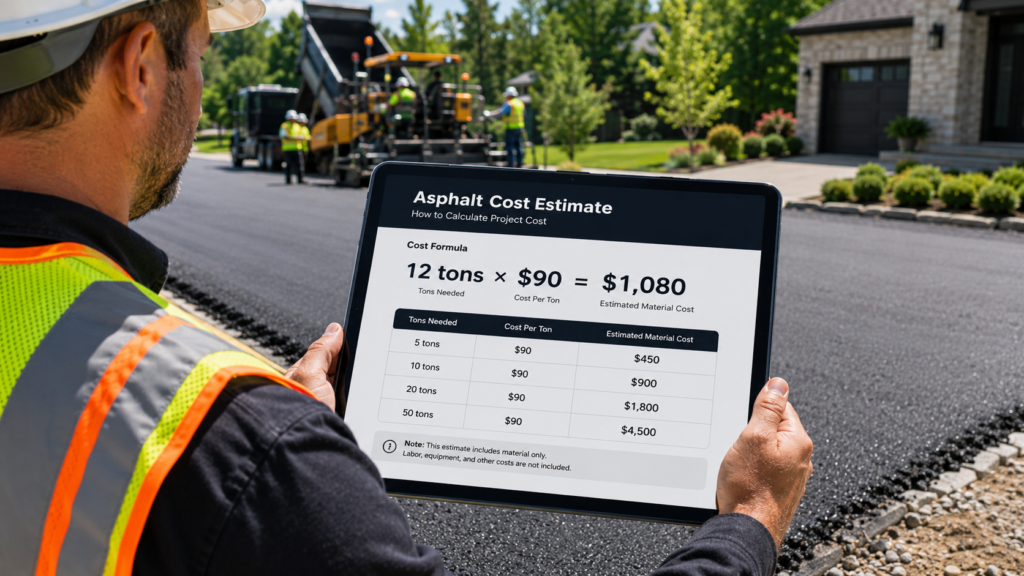
Asphalt Cost Estimate: How to Calculate Project Cost
After you calculate tons, you can estimate the material cost. The basic formula is tons multiplied by cost per ton.
If your project needs 12 tons and asphalt costs $90 per ton, the material estimate is $1,080. This does not include labor, grading, base stone, removal, delivery, compaction, permits, or repairs.
The full installed price can vary widely across the United States. Angi’s 2026 driveway cost guide lists asphalt driveway replacement at about $8 to $15 per square foot, with removal, materials, and labor included.
For a rough material-only estimate, use your local supplier’s price per ton. For a full project estimate, ask a contractor to include site prep, base work, paving, and cleanup.
| Tons Needed | Cost Per Ton | Estimated Material Cost |
| 5 tons | $90 | $450 |
| 10 tons | $90 | $900 |
| 20 tons | $90 | $1,800 |
| 50 tons | $90 | $4,500 |
This table is only a pricing example. Local prices may be higher or lower.
How Much Extra Asphalt Should You Order for Waste and Compaction?
It is common to add a small allowance above the calculated amount. This extra material helps cover uneven areas, edge loss, minor measuring errors, and jobsite waste.
Many projects use about 5% extra as a planning allowance. Holcim’s asphalt calculator page mentions adding a 5% margin to cover extra material needs.
If the project has many curves, rough edges, low spots, or an uneven base, the extra amount may need to be higher. If the area is very clean and simple, less extra may be needed.
Do not order a large amount of extra asphalt without checking with the supplier or contractor. Too much leftover hot mix can become waste.
| Calculated Tons | 5% Extra | Estimated Order |
| 8 tons | 0.4 tons | 8.4 tons |
| 10 tons | 0.5 tons | 10.5 tons |
| 25 tons | 1.25 tons | 26.25 tons |
| 100 tons | 5 tons | 105 tons |
This table shows how a small allowance grows with project size.
Example Asphalt Calculation for a Driveway
Here is a full driveway example in plain numbers.
The driveway is 60 feet long and 12 feet wide. The planned asphalt thickness is 3 inches. The density is 145 pounds per cubic foot. The material price is $90 per ton. A 5% extra allowance is added.
First, the area is 60 multiplied by 12, which equals 720 square feet. Next, 3 inches is divided by 12 to get 0.25 feet. The volume is 720 multiplied by 0.25, which equals 180 cubic feet.
The weight is 180 multiplied by 145, which equals 26,100 pounds. When that is divided by 2,000, the result is 13.05 tons. After adding 5%, the estimated order becomes 13.70 tons.
At $90 per ton, the material cost is about $1,233.
| Step | Result |
| Area | 720 sq ft |
| Thickness | 0.25 ft |
| Volume | 180 cu ft |
| Base tonnage | 13.05 tons |
| With 5% extra | 13.70 tons |
| Material cost at $90/ton | $1,233 |
This example shows how an asphalt calculator turns simple measurements into a usable estimate.
Common Asphalt Calculation Mistakes to Avoid
One common mistake is measuring only the main part of the project and forgetting the side areas. Driveway aprons, turnarounds, and parking pads can add more material than expected.
Another mistake is entering the thickness incorrectly. If the calculator asks for feet and you enter 3 for a 3-inch layer, the result will be much too high. Three inches should be entered as 0.25 feet if the field uses feet.
Some people also forget density. Without density, an asphalt volume calculator can show cubic yards, but it cannot give a reliable weight estimate.
A cost mistake is using material cost as the full project price. The real installed cost may include labor, base preparation, delivery, equipment, grading, removal, and cleanup.
A final mistake is ordering the exact calculated amount with no allowance. Small changes in the base, edges, or compaction can leave the crew short. A small waste allowance helps reduce that risk.
Asphalt Types and How They Affect Quantity and Cost
Different asphalt types can affect price, performance, and where the material should be used. The right mix depends on the project, traffic, weather, drainage, and local supplier options.
Hot mix asphalt is common for driveways, roads, and parking lots. Warm mix asphalt is produced at lower temperatures and may be used in many paving projects. Cold mix asphalt is often used for patching and temporary repairs. Porous asphalt is used when drainage is part of the design. Recycled asphalt may be used when available and suitable.
Recycling is a major part of the U.S. asphalt industry. A 2023 industry survey reported that 96.1 million tons of reclaimed asphalt pavement were used in asphalt mixtures, and 99.5% of producers reported using RAP that year, according to the Transportation Research Board record.
This matters because recycled asphalt can affect mix design, availability, cost, and sustainability. It does not mean every project should use the same mix. Your supplier or contractor can tell you which asphalt type fits the job.
| Asphalt Type | Common Use | Planning Note |
| Hot mix asphalt | Driveways, roads, parking lots | Strong common choice for many projects |
| Warm mix asphalt | Roads and commercial paving | Made at lower temperatures |
| Cold mix asphalt | Patches and temporary repairs | Often used for small repair work |
| Porous asphalt | Drainage-focused surfaces | Needs a planned base system |
| Recycled asphalt | Cost-aware or sustainability-focused jobs | Depends on supplier and mix design |
This table gives a simple view of how asphalt type can affect planning.
Base Layer, Subgrade, and Thickness: What to Check Before Ordering
The asphalt layer sits on top of a base and subgrade. If the base is weak, the asphalt surface may crack, sink, or rut even if the quantity estimate is correct.
The subgrade is the soil below the pavement. The base is the compacted layer above the soil and below the asphalt. Both layers help carry vehicle loads.
Before ordering asphalt, the site should be checked for soft spots, poor drainage, standing water, unstable soil, and uneven grading. These issues can change how much material is needed and how thick the pavement should be.
Thickness is not only a cost choice. It should match the base strength and traffic load. A driveway for cars may need less support than a parking area used by delivery trucks.
An asphalt calculator helps estimate tons, but it does not inspect the ground. For larger jobs, a paving contractor should check the base and site conditions before the final order.
When to Use an Asphalt Calculator and When to Call a Contractor
Use an asphalt calculator when you need a fast estimate for material quantity. It is helpful before calling suppliers, checking a quote, planning a budget, or comparing different thickness options.
A calculator is also useful for small repairs, home driveways, parking lot sections, and private paving projects where you already know the measurements.
Call a contractor when the project has heavy traffic, poor drainage, soft soil, a major slope, old pavement failure, or a large commercial area. These conditions need more than a quantity estimate.
A contractor can check grading, base preparation, compaction, drainage, and equipment access. These details affect the finished pavement.
The best approach is to use the calculator first, then use the estimate to ask better questions. You will know the approximate tons, square footage, thickness, and cost before the conversation starts.
How to Order Asphalt After Calculating Tons
After calculating tons, review the numbers before placing an order. Check the length, width, thickness, density, waste allowance, and cost per ton.
Then call a local asphalt supplier or paving contractor. Give them your project size, estimated tons, planned thickness, and project type.
You can say that your project is 720 square feet at 3 inches thick, and your estimate is about 13.7 tons with a 5% allowance. This gives the supplier enough detail to check the number and suggest the right mix.
Ask about minimum order size, delivery cost, truck capacity, mix type, timing, and temperature. If the asphalt is hot mix, make sure the crew is ready when the truck arrives.
A calculator helps you reach a strong estimate, but the supplier should confirm the final order based on the mix and delivery plan.
Frequently Asked Questions
How do I calculate asphalt tons from square feet?
To calculate asphalt tons from square feet, you need the total area, the asphalt thickness, and the asphalt density. First, multiply the length by the width to get square feet. Then convert the thickness from inches to feet. After that, multiply the square feet by the thickness and density. Finally, divide the weight by 2,000 to get tons.
For example, if your driveway is 600 square feet and you want 3 inches of asphalt, the thickness is 0.25 feet. If the asphalt density is 145 pounds per cubic foot, the estimate is about 10.88 tons before extra material. This is why an asphalt calculator square feet to tons tool is helpful. It saves time and helps you avoid wrong manual conversions.
What is the easiest way to know how much asphalt I need?
The easiest way to know how much asphalt I need is to use an asphalt calculator. You only need to enter the project length, width, thickness, and asphalt density. The calculator then gives you an estimate in tons, cubic yards, and sometimes cost.
This is much easier than trying to guess from square footage alone. Asphalt is measured by depth, too, not only by surface area. A 500-square-foot driveway at 2 inches thick will need less asphalt than the same driveway at 4 inches thick. That is why thickness should always be included in the estimate.
Is an asphalt tonnage calculator different from an asphalt tons calculator?
An asphalt tonnage calculator and an asphalt tons calculator usually do the same job. Both help you estimate how many tons of asphalt you need for a paving project. The wording is different, but the purpose is almost the same.
These calculators convert your project size into asphalt weight. They usually use length, width, thickness, and density to estimate tons. Some tools also show cubic yards and total material cost. If your main goal is to order asphalt, the tons result is the most useful number.
Can I use an asphalt calculator for a driveway?
Yes, you can use an asphalt calculator for a driveway. In fact, driveways are one of the most common uses for this type of tool. You can enter your driveway length, width, and planned thickness to estimate the amount of asphalt you need.
For a normal home driveway, thickness often ranges from 2 to 4 inches, depending on the base and vehicle use. If you park heavy trucks, trailers, or RVs, you may need a thicker asphalt layer. The calculator gives you a material estimate, but a contractor can help confirm the right thickness for your site.
Can an asphalt calculator estimate parking lot asphalt?
Yes, an asphalt paving calculator can estimate asphalt for parking lots. For best results, do not enter the full parking lot as one simple shape if different areas need different thicknesses. Parking spaces, drive lanes, entrances, and loading areas may need separate measurements.
A better method is to measure each section, calculate the asphalt needed for that section, and then add the totals together. This gives a more realistic estimate. It is also useful when a parking lot has both light car areas and heavier traffic areas.
What density should I use in an asphalt calculator?
Many asphalt calculators use 145 pounds per cubic foot as a common planning density. This is a useful starting point for many hot mix asphalt estimates. Still, asphalt density can change based on the mix type, aggregate, binder, and supplier.
If your supplier gives you the exact density for the mix, use that number in the calculator. This will give you a better estimate. If you do not have the supplier’s density, the default value can still help you create a close planning number before asking for a quote.
How much extra asphalt should I add to my estimate?
Many projects add around 5% extra asphalt to cover waste, uneven edges, low spots, and small measuring errors. This extra amount helps reduce the chance of running short during the paving job.
For example, if your asphalt ton calculator says you need 10 tons, adding 5% gives you 10.5 tons. If the job has curves, rough edges, or an uneven base, your contractor may suggest a little more. Do not add too much without checking because leftover hot mix can become wasted material.
Does an asphalt calculator include labor and delivery costs
Most basic asphalt calculator tools estimate material quantity only. Some tools also estimate material cost if you enter the price per ton. However, labor, delivery, grading, base work, old pavement removal, permits, and equipment are usually not included unless the calculator clearly asks for those costs.
This means the calculator is best for planning material quantity. If you want a full project price, you should use the calculator result as a starting point and then ask a local paving contractor for a complete quote.
How do I convert asphalt square yards to tons?
To convert square yards to tons, you need the asphalt thickness and density. Square yards only measure surface area. You still need depth to calculate volume, and you need density to calculate weight.
If you use an asphalt square yards to tons calculator, enter the square yards, thickness, and density. The calculator will convert the area into volume and then into tons. If your measurements are in square feet instead, use an asphalt calculator by square feet or an asphalt calculator square feet tool for a faster estimate.
Why do different asphalt calculators give different results?
Different calculators can give different results because they may use different density values, rounding methods, thickness units, or waste allowances. One calculator may use 145 pounds per cubic foot, while another may use a slightly different density.
Some calculators also show only material tons, while others include extra waste material. This is why your final number may not match across every asphalt weight calculator, asphalt volume calculator, or hot mix asphalt calculator. For the best result, use accurate measurements and confirm the final tons with your asphalt supplier.
Ready to Estimate Your Asphalt Quantity?
Use the asphalt calculator before you order material or ask for a quote. It helps you estimate tons, cubic yards, square footage, and cost from your own project measurements.
Measure the area carefully, choose the right thickness, use a realistic density, and add a small allowance for waste. Then confirm the final number with a local supplier or paving contractor.
A few minutes of calculation can help you avoid a short order, reduce waste, and plan your paving project with more confidence.