
Planning a paving project starts with knowing how much material you need and how much it will cost. Whether you are paving a residential driveway, a parking lot, a private road, or a commercial property, accurate estimates can help prevent material shortages, unnecessary expenses, and project delays. A reliable asphalt estimate calculator helps turn basic measurements into practical numbers that can be used for ordering materials and planning budgets.
Many property owners try to estimate asphalt needs manually, but even small calculation mistakes can affect the final cost of a project. That is why contractors, engineers, and homeowners often use an asphalt calculator to estimate area, volume, weight, tonnage, and overall costs before work begins.
If you want a quick way to estimate material requirements, you can use the Asphalt Estimate Calculator.
This guide explains how asphalt calculations work, how to measure paving areas correctly, how tonnage is determined, and how different project factors affect material estimates. You will also learn how an asphalt cost calculator, asphalt paving cost calculator, and asphalt tonnage calculator can help with complete project planning.
What Is an Asphalt Estimate Calculator?
An asphalt estimate calculator is a tool designed to estimate the amount of asphalt required for a paving project. It uses project dimensions, pavement thickness, and asphalt density to calculate how much material is needed. Instead of relying on rough estimates, users can enter measurements and receive a more accurate estimate of asphalt volume, weight, and tonnage.
A modern asphalt calculator often combines several functions into one tool. Depending on the platform, it may work as an asphalt volume calculator, asphalt weight calculator, asphalt tons calculator, and asphalt paving calculator at the same time. This makes it useful for homeowners, contractors, property managers, and developers who need reliable numbers before ordering materials.
The biggest advantage of using a calculator is consistency. Manual calculations can lead to errors, especially when dealing with large areas or multiple pavement sections. A calculator reduces those errors and saves time during project planning.
Who Should Use an Asphalt Estimate Calculator?
An asphalt estimation tool is useful for anyone involved in paving projects. Homeowners can use it before installing a driveway, while contractors may use it to prepare project bids and order materials. Commercial property owners can also benefit when planning parking lot construction or pavement repairs.
The tool is especially useful when calculating material quantities for projects with different pavement thicknesses or irregular shapes. A property manager planning a large parking lot, for example, may need a more detailed estimate than someone installing a small residential driveway.
Using an asphalt calculator square feet measurement method allows users to convert surface dimensions into meaningful material estimates. For larger jobs, contractors often combine these calculations with an asphalt calculator square feet to tons conversion process to determine how much asphalt should be ordered from suppliers.
How an Asphalt Estimate Calculator Works
An asphalt estimate calculator works by converting project dimensions into material quantities. The process begins by entering the length and width of the paving area. Once the surface area is known, the calculator uses the desired pavement thickness to determine volume.
After the volume is calculated, asphalt density is applied to estimate the total weight. Finally, the weight is converted into tons because asphalt is generally purchased and delivered by weight.
The process follows a simple sequence:
- Measure the paving area.
- Calculate total square footage.
- Apply pavement thickness.
- Determine asphalt volume.
- Convert volume into weight.
- Convert weight into tons.
- Estimate material costs if pricing data is available.
Many online tools combine all of these steps into one process. This allows users to estimate materials, compare project options, and create budgets more efficiently.
Information You Need Before Calculating Asphalt
Accurate results depend on accurate measurements. Before using an asphalt estimate calculator, gather all project information carefully. Missing or incorrect measurements can produce estimates that are either too high or too low.
At a minimum, you should know the total length and width of the paving area. You should also know the desired asphalt thickness and the type of asphalt being used. Different asphalt mixes may have slightly different density values, which can affect tonnage calculations.
The following information is typically required:
| Required Information | Purpose |
| Length | Determines project size |
| Width | Determines project size |
| Thickness | Calculates volume |
| Surface Shape | Improves accuracy |
| Asphalt Type | Affects density |
| Waste Allowance | Covers material loss |
Collecting accurate measurements before starting calculations makes the final estimate more reliable and helps reduce surprises during construction.
Measuring the Paving Area Correctly
Area measurement is the foundation of every asphalt estimate. Even the most advanced asphalt paving calculator cannot produce reliable results if the dimensions entered into the tool are incorrect.
For rectangular areas, the process is straightforward. Multiply the length by the width to determine square footage. This value becomes the basis for all later calculations.
For example, a driveway that measures 50 feet long and 12 feet wide covers 600 square feet. Once this number is known, it can be used to calculate volume, tonnage, and costs.
Contractors often verify measurements more than once because a small error in dimensions can become a large error when calculating total material requirements.
How to Measure Irregularly Shaped Areas
Many paving projects are not perfectly rectangular. Parking lots, commercial developments, and curved driveways often contain sections with different shapes.
The easiest method is to divide the area into smaller rectangles and measure each section separately. Once individual areas are calculated, they can be added together to determine the total project size.
For example, a parking lot may consist of three sections:
| Section | Area |
| Section A | 1,200 sq ft |
| Section B | 800 sq ft |
| Section C | 600 sq ft |
| Total Area | 2,600 sq ft |
This method helps improve accuracy and makes calculations easier when using an asphalt driveway calculator or larger commercial estimation tools.
Understanding Asphalt Thickness Requirements
Pavement thickness has a direct impact on material requirements. A thicker pavement section requires more asphalt, which increases both tonnage and cost.
Different projects require different thickness levels based on traffic loads and expected use. Residential driveways generally require less thickness than parking lots or commercial truck routes.
A driveway designed for passenger vehicles may perform well with 2 to 3 inches of compacted asphalt. Commercial properties that experience heavier traffic often require additional thickness to support greater loads.
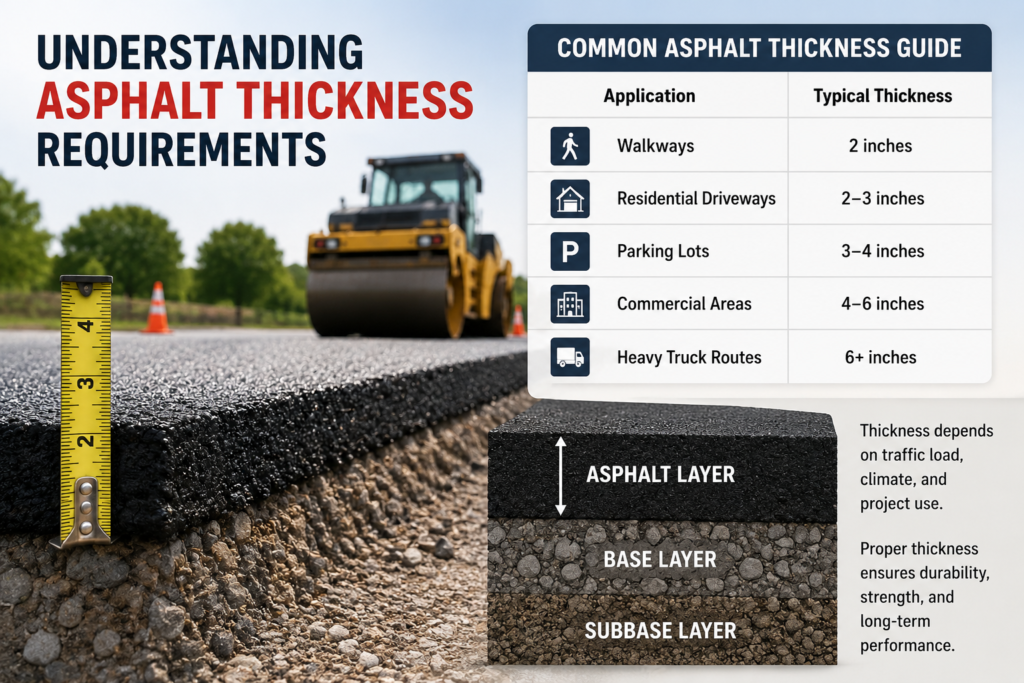
The table below shows common thickness ranges:
| Application | Typical Thickness |
| Walkways | 2 inches |
| Residential Driveways | 2–3 inches |
| Parking Lots | 3–4 inches |
| Commercial Areas | 4–6 inches |
| Heavy Truck Routes | 6+ inches |
If you are unsure about pavement depth, reviewing guidance from an asphalt driveway thickness resource can help determine the appropriate thickness for your project.
Choosing the correct thickness is one of the most important parts of project planning because it affects material quantities, pavement durability, and overall project cost.
Asphalt Density and Why It Matters
Density determines how much a given volume of asphalt weighs. Since asphalt is sold by weight, density plays a major role in material estimation.
Most paving calculations use an average asphalt density of approximately 145 pounds per cubic foot. However, actual density can vary depending on the asphalt mix being used.
When density values change, tonnage estimates also change. This is why contractors often confirm density values with suppliers before placing material orders.
Different asphalt mixes may include:
| Asphalt Type | Average Density |
| Hot Mix Asphalt | 140–150 lb/ft³ |
| Warm Mix Asphalt | 140–148 lb/ft³ |
| Dense-Graded Asphalt | Around 145 lb/ft³ |
A hot mix asphalt calculator takes these density values into account when estimating tonnage. Similarly, a crushed asphalt calculator may use different assumptions because recycled asphalt products can have different material characteristics.
Using accurate density values helps produce more realistic estimates and reduces the risk of overordering or underordering materials.
How to Calculate Asphalt Volume
Volume represents the amount of space asphalt will occupy after installation. It serves as the bridge between surface measurements and tonnage calculations.
The basic formula is simple:
Volume = Area × Thickness
If a driveway covers 2,000 square feet and the planned asphalt thickness is 3 inches, the thickness must first be converted into feet. Three inches equals 0.25 feet.
The calculation becomes:
2,000 × 0.25 = 500 cubic feet
This volume figure can then be used in an asphalt volume calculator to determine total material requirements.
For more detailed volume calculations, you can also use this dedicated resource: https://calcurax.com/asphalt-volume-calculator/
Understanding asphalt volume is useful because it helps property owners compare different pavement thickness options before deciding how much material to purchase.
How to Calculate Asphalt Tonnage
Tonnage is one of the most important measurements in paving projects because asphalt is usually purchased by the ton. Once the volume has been calculated, density is applied to determine weight and tonnage.
The standard formula is:
Tonnage = Volume × Density ÷ 2,000
Using the earlier example:
- Volume = 500 cubic feet
- Density = 145 pounds per cubic foot
The total weight becomes:
500 × 145 = 72,500 pounds
Dividing by 2,000 gives:
72,500 ÷ 2,000 = 36.25 tons
This means approximately 36.25 tons of asphalt would be required before accounting for waste allowances.
Many contractors use an asphalt ton calculator, asphalt tons calculator, or asphalt tonnage calculator to perform these calculations automatically. This improves accuracy and saves time when preparing project estimates.
Asphalt Tonnage Formula Explained
The tonnage formula can seem complicated at first, but it becomes much easier when broken into steps. Start by calculating the total paving area. Next, convert pavement thickness into feet and calculate the total volume. Once the volume is known, multiply it by the asphalt density to determine weight. Finally, divide the result by 2,000 because one ton equals 2,000 pounds.
This process is used by nearly every professional asphalt weight calculator and asphalt calculator square feet to tons tool available online.
If you want a dedicated guide focused entirely on tonnage calculations, visit: https://calcurax.com/calculate-asphalt-tonnage/
Accurate tonnage calculations help contractors order the right amount of material, control project costs, and keep paving operations running smoothly without interruptions.
Using an Asphalt Cost Calculator for Budget Planning
Knowing how much asphalt you need is only one part of planning a paving project. The next step is understanding how much the project will cost. This is where an asphalt cost calculator becomes useful. Instead of guessing expenses, property owners and contractors can estimate costs before ordering materials or scheduling work.
An asphalt paving cost calculator combines material quantities with pricing information to create a more realistic budget. The calculator typically uses square footage, asphalt thickness, tonnage requirements, labor rates, and transportation expenses to estimate total project costs.
For many projects, asphalt is only one portion of the budget. Site preparation, grading, drainage work, equipment rental, and labor can add substantial costs. A detailed estimate allows property owners to compare options and avoid budget surprises.
A typical budgeting process includes calculating the paving area, estimating asphalt volume, converting that volume into tons, and applying local material prices. Once labor and equipment costs are added, a complete project estimate can be created.
The table below shows common cost factors that affect most paving projects:
| Cost Factor | Impact on Budget |
| Asphalt Material | High |
| Labor | High |
| Equipment | Moderate to High |
| Transportation | Moderate |
| Site Preparation | Moderate to High |
| Drainage Work | Moderate |
| Base Material | Moderate |
Property owners who want a more detailed breakdown of paving expenses can use this dedicated asphalt cost calculator.
Using cost estimates early in the planning stage makes it easier to compare project options and select a paving solution that fits the available budget.
Factors That Affect Asphalt Paving Costs
Every paving project is different, which means costs can vary widely even when projects appear similar. Several factors influence how much asphalt is needed and how much the final project will cost.
Project size is one of the largest cost drivers. Larger paving areas require more material, labor, and equipment time. While the total cost increases, larger projects may sometimes benefit from lower costs per square foot.
Pavement thickness also affects costs. A parking lot built at four inches thick requires considerably more asphalt than a driveway built at two inches thick. Because asphalt is sold by weight, increased thickness directly increases material expenses.
Site conditions can also influence project pricing. If the existing surface requires removal or the soil needs stabilization, preparation costs may rise before paving begins.
Material selection is another factor. Different asphalt mixes have different production costs and performance characteristics. Hot mix asphalt remains the most common paving material, but some projects use specialty mixes designed for specific applications.
Transportation expenses can also affect pricing. Asphalt plants located farther from the project site may increase delivery costs due to fuel usage and travel time.
The table below summarizes common factors that affect paving costs:
| Factor | Cost Impact |
| Project Size | Higher Area Increases Cost |
| Thickness | More Asphalt Required |
| Site Preparation | Additional Labor and Equipment |
| Material Type | Different Mix Prices |
| Transportation | Delivery Expenses |
| Drainage Improvements | Additional Construction Costs |
Understanding these factors helps property owners create more realistic budgets and compare contractor proposals more effectively.
Asphalt Paving Cost Calculator vs Manual Estimation
Some people still calculate paving costs manually using spreadsheets and formulas. While manual calculations can work for simple projects, they often require more time and increase the possibility of mistakes.
An asphalt paving cost calculator performs calculations automatically. After entering project dimensions and thickness requirements, the calculator estimates material quantities and associated costs within seconds.
Manual estimation requires multiple steps. Users must calculate area, convert thickness measurements, determine volume, calculate weight, convert pounds into tons, and then apply pricing information. Errors can occur at any stage of the process.
The comparison below highlights the differences:
| Feature | Asphalt Paving Cost Calculator | Manual Estimation |
| Speed | Fast | Slower |
| Accuracy | High | Depends on User |
| Error Risk | Lower | Higher |
| Cost Forecasting | Automatic | Manual |
| Tonnage Conversion | Included | Separate Calculation |
For larger projects with multiple paving sections, calculators can save considerable time while improving estimate consistency.
Asphalt Material Estimator for Different Project Types
Not all paving projects require the same amount of asphalt. Material estimates vary depending on traffic loads, project size, pavement thickness, and expected usage.
A residential driveway experiences different traffic conditions than a commercial parking lot or industrial roadway. Because of these differences, each project type should be estimated individually.
An asphalt material estimator helps determine how much asphalt is required based on the intended use of the pavement. It also helps identify situations where thicker pavement or stronger base materials may be needed.
Project categories commonly include residential driveways, parking lots, private roads, commercial facilities, and industrial sites. Each category has unique material requirements that influence both tonnage and cost calculations.
Estimating Asphalt for Residential Driveways
Residential driveways are one of the most common paving projects in the United States. Most driveways are designed to support passenger vehicles, which means material requirements are usually lower than those for commercial facilities.
A typical driveway may range from 10 to 24 feet in width and 20 to 100 feet in length. The exact dimensions depend on property size, vehicle needs, and local design preferences.
An asphalt driveway calculator helps homeowners estimate how much material is needed before contacting contractors or ordering asphalt. By entering driveway measurements and desired thickness, users can quickly estimate volume and tonnage requirements.
Cost planning is equally important for homeowners. An asphalt driveway cost calculator can estimate potential project expenses based on driveway dimensions and local asphalt pricing.
For homeowners interested in detailed driveway pricing information, this guide provides additional insight: https://calcurax.com/asphalt-driveway-cost-calculator/
Using accurate driveway estimates helps reduce material waste and supports better budgeting decisions.
Estimating Asphalt for Parking Lots
Parking lots require more detailed planning than residential driveways because they serve larger traffic volumes and often contain multiple functional areas.
A parking lot may include driving lanes, parking stalls, loading areas, and access points. Each section may experience different traffic loads, which can influence pavement thickness requirements.
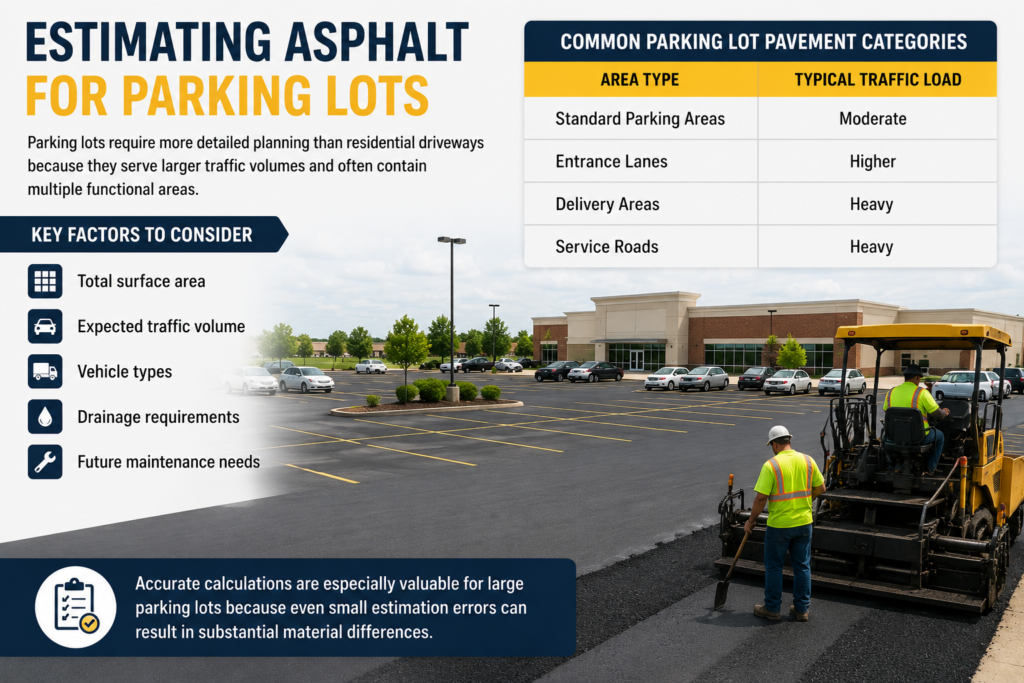
When estimating asphalt for parking lots, planners typically evaluate:
- Total surface area
- Expected traffic volume
- Vehicle types
- Drainage requirements
- Future maintenance needs
The table below shows common parking lot pavement categories:
| Area Type | Typical Traffic Load |
| Standard Parking Areas | Moderate |
| Entrance Lanes | Higher |
| Delivery Areas | Heavy |
| Service Roads | Heavy |
Accurate calculations are especially valuable for large parking lots because even small estimation errors can result in substantial material differences.
Estimating Asphalt for Private Roads
Private roads often require stronger pavement structures than residential driveways because they serve a larger number of vehicles and may experience more frequent traffic.
Roadway estimates typically begin with measurements of total road length and width. Once the area is calculated, planners determine pavement thickness based on expected traffic loads and local conditions.
Private road estimates often include additional considerations such as drainage improvements, shoulder construction, and base preparation. These factors can increase both material requirements and project costs.
Because roadway projects can involve large quantities of asphalt, accurate tonnage calculations are especially important. Underestimating material needs may interrupt paving operations and increase delivery expenses.
Estimating Asphalt for Commercial Paving Projects
Commercial paving projects often involve the largest asphalt quantities and the highest budgets. Shopping centers, industrial facilities, office parks, distribution centers, and municipal projects all require careful planning.
Commercial estimates usually consider more than just pavement dimensions. Designers must account for traffic patterns, loading zones, turning movements, and long-term durability requirements.
The table below shows typical commercial pavement thickness ranges:
| Commercial Application | Typical Thickness |
| Light Commercial | 3–4 Inches |
| Medium Commercial | 4–5 Inches |
| Heavy Commercial | 5–6+ Inches |
Because commercial projects often involve significant material quantities, even a small percentage error can translate into many additional tons of asphalt. This makes accurate estimation one of the most important parts of commercial paving planning.
Hot Mix Asphalt vs Warm Mix Asphalt Estimation
Different asphalt mixes can influence project planning and material calculations. The two most common options are hot mix asphalt and warm mix asphalt.
Hot mix asphalt is produced at higher temperatures and remains the most widely used paving material in the United States. Warm mix asphalt is produced at lower temperatures and may offer environmental and operational advantages under certain conditions.
While the overall estimation process remains similar, density values may vary slightly between asphalt mixes. Because tonnage calculations depend on density, using the correct material information helps improve estimate accuracy.
The comparison below highlights some key differences:
| Feature | Hot Mix Asphalt | Warm Mix Asphalt |
| Production Temperature | Higher | Lower |
| Fuel Usage | Higher | Lower |
| Emissions | Higher | Lower |
| Workability | Standard | Improved |
A hot mix asphalt calculator may use slightly different density assumptions than calculators designed for alternative asphalt products.
How Base Layers Affect Asphalt Material Requirements
The asphalt surface receives most of the attention, but the base layer beneath the pavement plays a major role in long-term performance. A properly prepared base supports traffic loads, improves drainage, and helps prevent pavement failures.
When the base layer is weak or unstable, additional pavement thickness may be needed to compensate for reduced support. This can increase asphalt requirements and overall project costs.
Common base materials include crushed stone, aggregate base, and recycled construction materials. The choice depends on traffic loads, soil conditions, and local construction practices.
A strong base can improve pavement life and reduce future maintenance expenses. Because of this, many contractors evaluate base conditions before finalizing material estimates.
Common Asphalt Calculation Mistakes to Avoid
Many estimation problems occur because of simple calculation errors. While calculators reduce manual mistakes, users still need to provide accurate information.
One common issue is incorrect measurements. A small error in length or width can affect every later calculation. Measuring the paving area carefully helps improve estimate reliability.
Another mistake involves thickness assumptions. Some users enter loose asphalt thickness rather than compacted thickness, which can produce inaccurate results.
Density values can also create problems. Using the wrong density may affect tonnage calculations and result in material shortages or excess purchases.
Many projects also overlook waste allowances. Material loss during transportation, placement, and finishing is normal, which is why contractors often add extra material to their estimates.
Carefully reviewing project measurements, density assumptions, and thickness requirements helps improve estimate accuracy and reduce costly surprises during construction.
How Weather Conditions Impact Asphalt Estimates
Weather can affect both asphalt installation and project planning. While measurements and calculations determine how much asphalt is required, weather conditions often influence when paving can take place and how efficiently the work can be completed.
Temperature plays a major role in asphalt performance during installation. Asphalt must remain workable long enough to be properly spread and compacted. Extremely cold temperatures can cause asphalt to cool too quickly, making compaction more difficult. On the other hand, very hot conditions may require adjustments in scheduling and material handling.
Rain is another factor that can affect paving projects. Wet conditions can delay construction, slow site preparation, and affect the condition of the base layer. If paving is performed on a wet surface, the finished pavement may not perform as expected.
Property owners and contractors often review weather forecasts before scheduling asphalt deliveries. Planning around weather conditions helps reduce delays and supports smoother project execution.
The table below shows how different weather conditions can affect paving projects:
| Weather Condition | Potential Impact |
| Cold Temperatures | Faster Asphalt Cooling |
| Hot Temperatures | Material Handling Adjustments |
| Rainfall | Project Delays |
| High Humidity | Slower Base Drying |
| Freeze-Thaw Cycles | Increased Pavement Stress |
Weather may not directly change tonnage calculations, but it can influence project timing, labor scheduling, and overall construction planning.
Asphalt Coverage Rates by Thickness
Coverage rates help estimate how much area a specific amount of asphalt can cover. As pavement thickness increases, each ton of asphalt covers less surface area.
Understanding coverage rates can help property owners compare different paving options and estimate material requirements before ordering asphalt.
For example, one ton of asphalt spread at one inch thick covers considerably more area than one ton spread at four inches thick. This relationship is why thickness has such a strong effect on total project cost.
The table below provides general coverage estimates:
| Compacted Thickness | Approximate Coverage Per Ton |
| 1 Inch | 160–165 sq ft |
| 2 Inches | 80–85 sq ft |
| 3 Inches | 53–55 sq ft |
| 4 Inches | 40–42 sq ft |
| 5 Inches | 32–34 sq ft |
These values are estimates and may vary depending on asphalt density and mix design. A dedicated asphalt calculator square feet to tons tool can provide more accurate project-specific estimates based on actual dimensions and thickness requirements.
Asphalt Estimate Calculator Examples
Many people find asphalt calculations easier to understand when they see practical examples. The examples below show how a typical driveway and parking lot estimate may be calculated using an asphalt estimate calculator.
Driveway Calculation Example
Suppose a homeowner plans to install a driveway that measures 60 feet long and 12 feet wide. The planned pavement thickness is 3 inches.
The first step is calculating the total area:
60 × 12 = 720 square feet
The next step is converting the thickness into feet:
3 inches ÷ 12 = 0.25 feet
The volume calculation becomes:
720 × 0.25 = 180 cubic feet
Using an average asphalt density of 145 pounds per cubic foot:
180 × 145 = 26,100 pounds
Converting weight into tons:
26,100 ÷ 2,000 = 13.05 tons
The estimated asphalt requirement is approximately 13 tons before adding any waste allowance.
This type of calculation can be completed automatically using an asphalt driveway calculator, making project planning much easier for homeowners.
Parking Lot Calculation Example
Now consider a parking lot measuring 200 feet long and 100 feet wide with a planned thickness of 4 inches.
The total area is:
200 × 100 = 20,000 square feet
The thickness conversion becomes:
4 inches ÷ 12 = 0.333 feet
Volume calculation:
20,000 × 0.333 = 6,660 cubic feet
Weight calculation:
6,660 × 145 = 965,700 pounds
Tonnage calculation:
965,700 ÷ 2,000 = 482.85 tons
The project would require approximately 483 tons of asphalt before waste factors are applied.
Large projects like this demonstrate why professional contractors rely on an asphalt tons calculator or an asphalt ton calculator rather than performing calculations manually.
Benefits of Using an Asphalt Project Calculator
An asphalt project calculator provides several advantages during the planning process. Whether the project involves a driveway, parking lot, roadway, or commercial facility, accurate estimates support better decision-making.
One major benefit is improved accuracy. Manual calculations require several conversion steps, and mistakes can occur at any point in the process. A calculator performs these calculations automatically and consistently.
Another benefit is time savings. Instead of calculating area, volume, weight, and tonnage separately, users can enter measurements and receive results within seconds.
Project budgeting also becomes easier. By combining quantity estimates with material pricing, property owners can prepare more realistic budgets before construction begins.
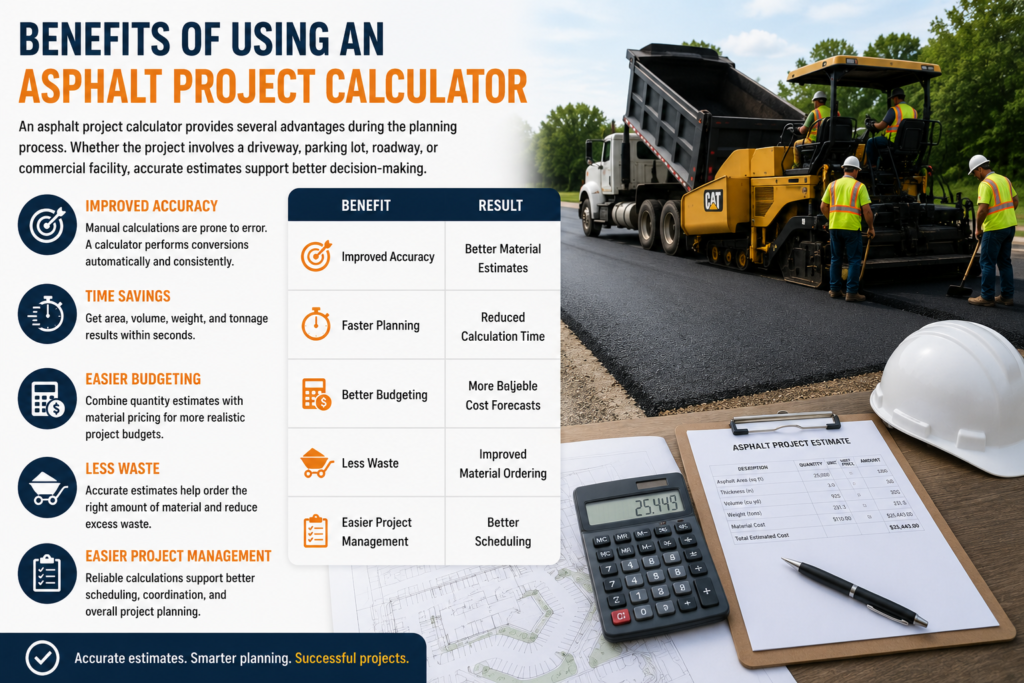
The table below summarizes common benefits:
| Benefit | Result |
| Improved Accuracy | Better Material Estimates |
| Faster Planning | Reduced Calculation Time |
| Better Budgeting | More Reliable Cost Forecasts |
| Less Waste | Improved Material Ordering |
| Easier Project Management | Better Scheduling |
These advantages make calculators valuable for both small residential projects and large commercial developments.
When to Use an Asphalt Cost Calculator
An asphalt cost calculator can be used at several stages of a project. Many people wait until construction is about to begin, but budgeting often works best when estimates are prepared early.
Property owners frequently use calculators during the project evaluation stage. This helps determine whether a project fits within the available budget before requesting contractor bids.
Contractors also use calculators while preparing proposals. Accurate estimates help create more competitive bids and reduce the risk of underestimating material requirements.
A calculator can be useful when:
- Planning a new driveway
- Expanding a parking lot
- Replacing old pavement
- Comparing paving options
- Evaluating project budgets
Using cost estimates early provides more flexibility when selecting materials and pavement thickness options.
How Contractors Estimate Asphalt Quantities
Professional estimators follow a structured process when determining asphalt requirements. While software and calculators help perform calculations, accurate estimates still depend on reliable project information.
The process usually begins with a site visit. Contractors evaluate the existing pavement, drainage conditions, accessibility, and soil characteristics.
Next, detailed measurements are collected. These measurements form the basis for area calculations and later material estimates.
After dimensions are confirmed, pavement thickness requirements are selected based on expected traffic loads and project goals.
Once measurements and thickness values are known, estimators calculate volume, weight, and tonnage requirements. Many contractors then add a waste factor to account for material losses during transportation and installation.
This process helps produce accurate material estimates and supports more reliable project pricing.
Asphalt Estimate Calculator vs Asphalt Tonnage Calculator
Although these tools are closely related, they are not identical. An asphalt estimate calculator provides a broader range of calculations, while an asphalt tonnage calculator focuses primarily on weight conversion.
An estimate calculator typically calculates area, volume, weight, tonnage, and sometimes cost. A tonnage calculator usually focuses on converting volume into tons.
The comparison below highlights the differences:
| Feature | Asphalt Estimate Calculator | Asphalt Tonnage Calculator |
| Area Calculation | Yes | |
| Volume Calculation | Yes | |
| Weight Calculation | Yes | |
| Tonnage Calculation | Yes | |
| Cost Estimation | Often Included | |
| Primary Purpose | Full Project Planning |
For complete project planning, an asphalt estimate calculator generally provides more information than a standalone asphalt tonnage calculator.
Asphalt Estimate Calculator vs Asphalt Paving Cost Calculator
A similar comparison applies to the asphalt paving cost calculator. While both tools support project planning, their primary purposes are different.
An estimate calculator focuses on material quantities, while a paving cost calculator focuses on budgeting and project expenses.
The table below explains the distinction:
| Feature | Asphalt Estimate Calculator | Asphalt Paving Cost Calculator |
| Area Calculations | Yes | Sometimes |
| Volume Calculations | Yes | Limited |
| Tonnage Calculations | Yes | Sometimes |
| Cost Forecasting | Basic | Main Function |
| Budget Planning | Moderate | Extensive |
Many modern calculators combine both functions into a single tool, making project planning easier and more efficient.
Tips for Improving Estimate Accuracy
Even the best calculators depend on accurate information. Small errors in measurements or assumptions can affect the final estimate.
One of the easiest ways to improve accuracy is to verify measurements more than once. Rechecking dimensions can help identify mistakes before calculations begin.
Users should also confirm pavement thickness requirements before estimating materials. Thickness changes have a direct effect on tonnage and project costs.
Density assumptions should be reviewed whenever possible. Different asphalt mixes may have slightly different densities, which can affect weight calculations.
Adding a waste allowance is another common practice. Contractors often include additional material to account for handling losses and field adjustments.
Careful attention to these details can improve estimate reliability and support better project planning.
Signs Your Asphalt Estimate May Be Incorrect
Several warning signs can indicate that an asphalt estimate should be reviewed.
One common issue is unusually low material quantities. If the estimate appears much lower than similar projects, measurements or thickness values may need to be verified.
Large differences between contractor estimates can also suggest that calculations should be reviewed more carefully.
Another warning sign is missing waste allowances. Projects that do not include extra material may face shortages during construction.
Inconsistent unit conversions can also create problems. Mixing feet, inches, yards, and meters without proper conversion often leads to inaccurate estimates.
Reviewing calculations before ordering materials helps identify these issues and reduces the likelihood of costly mistakes.
Frequently Asked Questions
How Much Asphalt Do I Need Per Square Foot?
The amount of asphalt needed per square foot depends mainly on the thickness of the pavement and the density of the material being used. A thin layer requires less material, while thicker pavement needs more asphalt to properly cover and strengthen the surface. For example, a 2-inch residential layer uses much less asphalt per square foot compared to a 4-inch commercial surface. This is why an asphalt calculator square feet tool is often used to get a more accurate estimate before ordering material.
How Many Tons of Asphalt Are Needed for a Driveway?
The total tons of asphalt needed for a driveway depend on its length, width, and planned thickness. A small residential driveway may require around 10 to 20 tons of asphalt, while larger or wider driveways can require significantly more. Using an asphalt driveway calculator or an asphalt driveway cost calculator helps homeowners get a more exact number based on real measurements instead of rough guesses.
What Thickness of Asphalt Is Recommended?
Recommended asphalt thickness depends on how the surface will be used. Residential driveways usually perform well with 2 to 3 inches of compacted asphalt. Parking lots generally require 3 to 4 inches because of higher traffic load. Heavy commercial areas or truck routes may need 5 inches or more for long-term durability. A proper asphalt paving calculator helps match thickness with expected traffic conditions.
How Accurate Is an Asphalt Estimate Calculator?
An asphalt estimate calculator is generally very reliable when accurate measurements and correct inputs are used. The final result depends on correct length, width, thickness, and density values. If these inputs are precise, the calculator can provide a close estimate of required material and cost, making it useful for planning and budgeting projects before construction begins.
What is the difference between the Asphalt Estimate Calculator and the Asphalt Tonnage Calculator?
An asphalt estimate calculator provides a complete overview of a project, including area, volume, and sometimes cost. An asphalt tonnage calculator focuses mainly on converting volume into weight. For full project planning, the estimate calculator gives more detailed information, while the tonnage calculator is used mainly for ordering material.
Can I Use an Asphalt Calculator for Any Type of Project?
Yes, an asphalt calculator can be used for residential driveways, parking lots, private roads, and commercial paving projects. The key is entering accurate measurements and selecting the correct thickness based on traffic load and surface use.
What Is the Role of Asphalt Density in Calculations?
Asphalt density determines how much a specific volume of asphalt weighs. Since asphalt is usually sold by weight, density plays an important role in converting volume into tons. Different mixes like hot mix asphalt or warm mix asphalt may have slightly different density values, which can affect final calculations.
Why Do I Need a Waste Allowance in Asphalt Estimates?
A waste allowance is added to account for small material losses during transportation, spreading, and compaction. Without this buffer, a project may run short on material. Most contractors include 5–10% extra asphalt to avoid delays during installation.
What Happens If I Underestimate Asphalt Quantity?
If asphalt is underestimated, the project may face delays while waiting for additional material. This can increase labor costs and slow down construction. In some cases, mismatched layers can also affect pavement quality. That is why using an asphalt ton calculator or asphalt calculator cost tool is recommended before ordering.
Can Weather Affect Asphalt Requirements?
Weather does not directly change the calculated asphalt quantity, but it can affect how the material performs during installation. Cold weather can make compaction harder, while rain can delay work. Proper planning ensures material is ready when conditions are suitable for paving.
Final Thoughts on Using an Asphalt Estimate Calculator
An asphalt estimate calculator is one of the most useful tools available for planning paving projects. It helps property owners, contractors, and project managers estimate material requirements, calculate tonnage, and create realistic budgets before construction begins.
By understanding pavement thickness, asphalt density, volume calculations, and tonnage requirements, users can make better decisions about material ordering and project planning. Tools such as an asphalt calculator, asphalt paving calculator, asphalt weight calculator, asphalt price calculator, asphalt calculator cost estimator, and asphalt ton calculator simplify calculations that would otherwise require multiple formulas and conversions.
Whether you are planning a driveway, parking lot, roadway, or commercial paving project, accurate estimates help reduce waste, improve budgeting, and support smoother construction operations.