
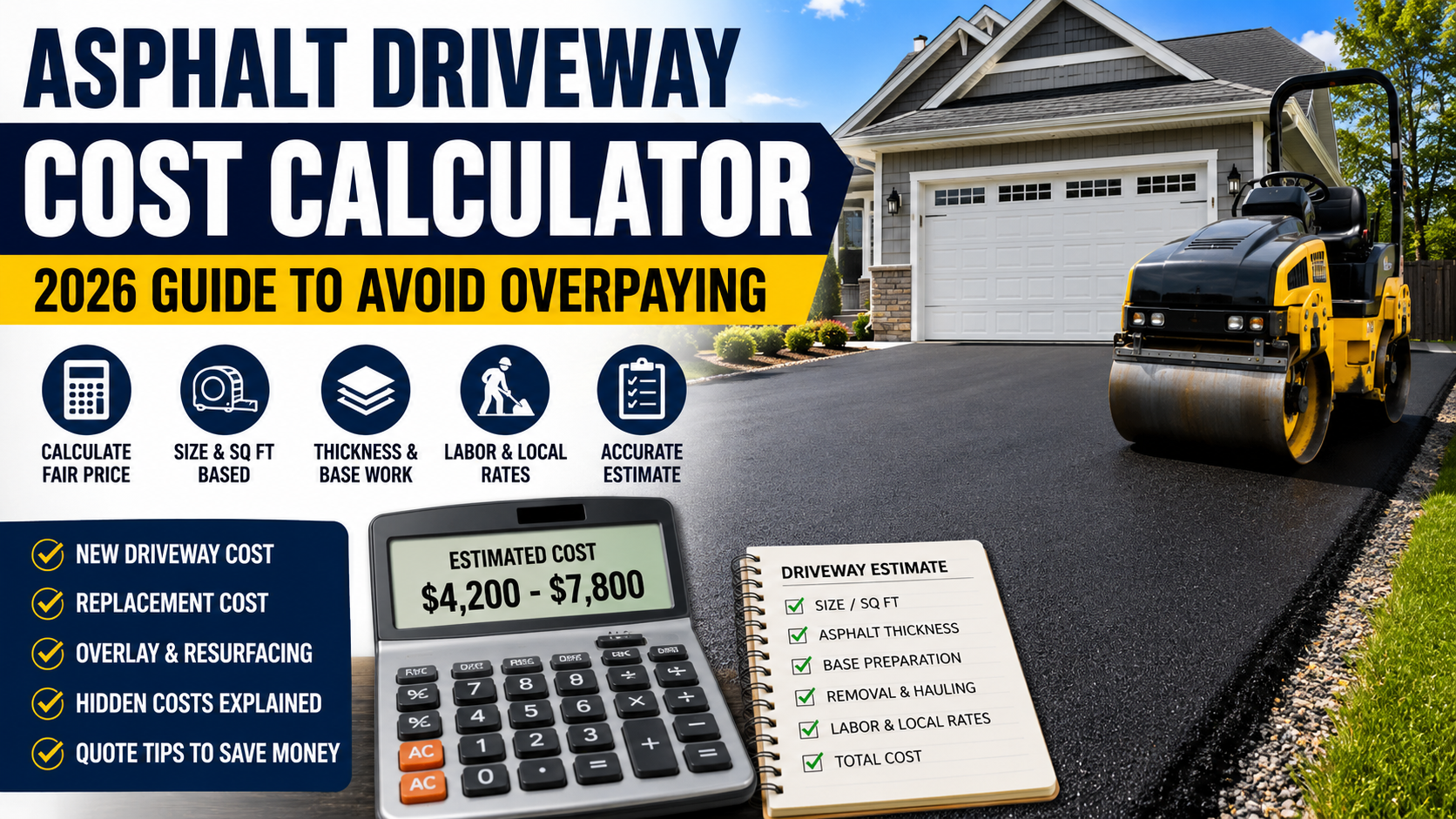
An Asphalt Driveway Cost Calculator: 2026 Guide to Avoid Overpaying helps U.S. homeowners check a fair price before they call a paving company. Many people search for an asphalt driveway cost calculator because they want a clear driveway asphalt estimate based on size, square footage, labor, asphalt thickness, removal, grading, and local rates. This guide explains average asphalt driveway cost, cost per square foot, real driveway size examples, replacement cost, overlay cost, hidden charges, quote tips, and how to use a paving cost calculator before paying for the project.
What Is an Asphalt Driveway Cost Calculator?
An asphalt driveway cost calculator is a simple tool that helps you estimate the price of an asphalt driveway before you speak with contractors. It usually asks for your driveway length, width, project type, and sometimes asphalt depth. Then it gives a price range based on the total square footage and average paving rates.
This type of tool is helpful because most homeowners do not know what a fair driveway price looks like. One contractor may quote a lower number because the quote does not include old driveway removal. Another contractor may quote a higher number because it includes grading, base repair, hauling, and cleanup. Without a basic estimate, it is hard to compare both quotes.
A calculator does not replace an in-person quote. A contractor still needs to inspect the ground, base layer, drainage, slope, and access. But a calculator gives you a smart starting point, so you can avoid guessing.
For 2026, Angi reports that a new asphalt driveway often costs about $7 to $13 per square foot. HomeGuide gives a similar planning range of about $5 to $12+ per square foot for asphalt driveway paving. These ranges explain why homeowners should calculate the cost before agreeing to a quote.
Why Use an Asphalt Driveway Cost Calculator Before Hiring a Contractor?
Using an asphalt calculator before hiring a contractor helps you understand the price range before anyone tries to sell you a job. It also helps you ask better questions. Instead of only asking, “How much is the driveway?” you can ask what the quote includes.
A good driveway quote should explain the surface size, asphalt thickness, base work, grading, removal, drainage, cleanup, and warranty. If the quote only gives one final number, you may not know whether you are getting a fair deal or a thin job that may fail early.
This matters because the cheapest quote is not always the best choice. A driveway can look fine on day one and still fail early if the base is weak or the asphalt layer is too thin. Water can collect, cracks can return, and low spots can form when the site is not prepared the right way.
A calculator helps you compare the contractor’s price against a realistic range. If the contractor’s quote is much higher than your estimate, you can ask why. If it is much lower, you can ask what is missing. That one step can save you from overpaying or choosing poor work.
How the Asphalt Driveway Cost Calculator Works in 2026
An asphalt driveway calculator usually starts with square footage. The tool multiplies the length of your driveway by the width. Then it applies a cost-per-square-foot range based on the type of asphalt work.
For example, a driveway that is 50 feet long and 12 feet wide is 600 square feet. If the estimated cost is $7 to $13 per square foot, the total estimate may fall between $4,200 and $7,800 before extra work. That price may change if the project needs old pavement removal, base repair, drainage fixes, thicker asphalt, or special access.
In 2026, many online cost sources show asphalt pricing in a wide range because every driveway is different. HomeAdvisor lists asphalt driveways around $7 to $15 per square foot, while NerdWallet reports new asphalt driveways at about $7 to $13 per square foot and replacement projects around $8 to $15 per square foot.
The calculator gives the first estimate. The contractor’s site visit gives the final price.
Inputs You Need Before Calculating the Cost
Before using an asphalt cost calculator, measure your driveway as carefully as possible. Most driveway estimates begin with square footage, so length and width are the first numbers you need. If your driveway is not a simple rectangle, divide it into smaller sections and add them together.
You should also know whether the job is a new installation, resurfacing, overlay, replacement, repair, or sealing. These project types do not cost the same. A new driveway may need grading and base work. A replacement may need old pavement removal. A resurfacing project may cost less if the existing base is still strong.
The condition of the current surface matters too. A driveway with deep cracks, sinking areas, standing water, or soft spots may need more preparation than a driveway with light surface wear. That extra preparation can raise the final cost.
A more accurate estimate usually includes driveway size, project type, asphalt thickness, base condition, drainage, slope, local labor rates, and equipment access.
Simple Formula Behind a Driveway Asphalt Estimate
The basic formula behind a driveway asphalt estimate is simple. You multiply the driveway square footage by the expected cost per square foot.
A 600-square-foot driveway at $10 per square foot would cost about $6,000. A 1,000-square-foot driveway at the same rate would cost about $10,000. This is only a planning estimate, but it helps you understand how size changes the price.
A better estimate also looks at asphalt depth, base layer thickness, old surface removal, hauling, drainage, and labor. These items can move the final price above the basic square-foot estimate.
Some contractors also calculate asphalt by the ton. That is more common when they need to estimate material volume for a deeper surface or larger project. This is where an asphalt calculator cost tool can help you understand both square-foot cost and material quantity.
Average Asphalt Driveway Cost in 2026
The average asphalt driveway cost in 2026 often falls between $5 and $15 per square foot, depending on the source, location, site condition, and project type. A small basic driveway may cost a few thousand dollars, while a larger or more complex driveway can cost much more.
Angi lists new asphalt driveway installation at about $7 to $13 per square foot, including labor and materials. HomeGuide reports asphalt driveway paving at about $5 to $12+ per square foot, with a 600-square-foot two-car driveway averaging about $3,000 to $7,200.
The reason the range is wide is simple. A flat driveway with a strong base is easier to pave. A sloped driveway with poor drainage, tree roots, old concrete removal, and weak soil will cost more.
Here is a simple planning table for 2026 asphalt driveway pricing.
| Cost Item | Common 2026 Planning Range |
| New asphalt driveway | $7 to $13 per square foot |
| Asphalt driveway paving | $5 to $12+ per square foot |
| Asphalt replacement | $8 to $15 per square foot |
| Asphalt overlay | $3 to $7 per square foot |
| 600-square-foot driveway | $3,000 to $7,800 in many estimates |
This table gives a fair starting point. Your real price still depends on your property and local contractor rates.
Asphalt Driveway Cost Per Square Foot
Cost per square foot is the number most homeowners should look at first. It makes quotes easier to compare because driveways come in different sizes.
If one contractor quotes $6,500 for a 600-square-foot driveway, that is about $10.83 per square foot. If another quotes $5,400 for the same size, that is $9 per square foot. The lower quote may look better, but you still need to check what is included.
A fair per-square-foot price may include asphalt material, labor, equipment, basic installation, and compacting. It may not include old driveway removal, grading, drainage repair, base replacement, permits, or sealing.
That is why the price per square foot should never be used alone. It should be used with the project scope. A higher per-square-foot quote can be fair if it includes stronger base preparation and cleanup. A lower quote can become expensive later if extra work is added after the job starts.
For many U.S. homeowners, a safe planning range is about $7 to $13 per square foot for a new asphalt driveway and about $8 to $15 per square foot for replacement work, based on current cost ranges from Angi, HomeAdvisor, and NerdWallet.
Use this Ultimate Asphalt Driveway Thickness Guide to understand proper asphalt thickness and prevent expensive installation errors.
Driveway Asphalt Estimate by Size
A driveway’s size has the biggest effect on the final price. More square footage means more asphalt, more labor, more base material, more compaction, and more time on site.
A small one-car driveway may be around 300 to 400 square feet. A common two-car driveway may be around 600 square feet. A long rural driveway or wide parking area may be 1,000 square feet or more.
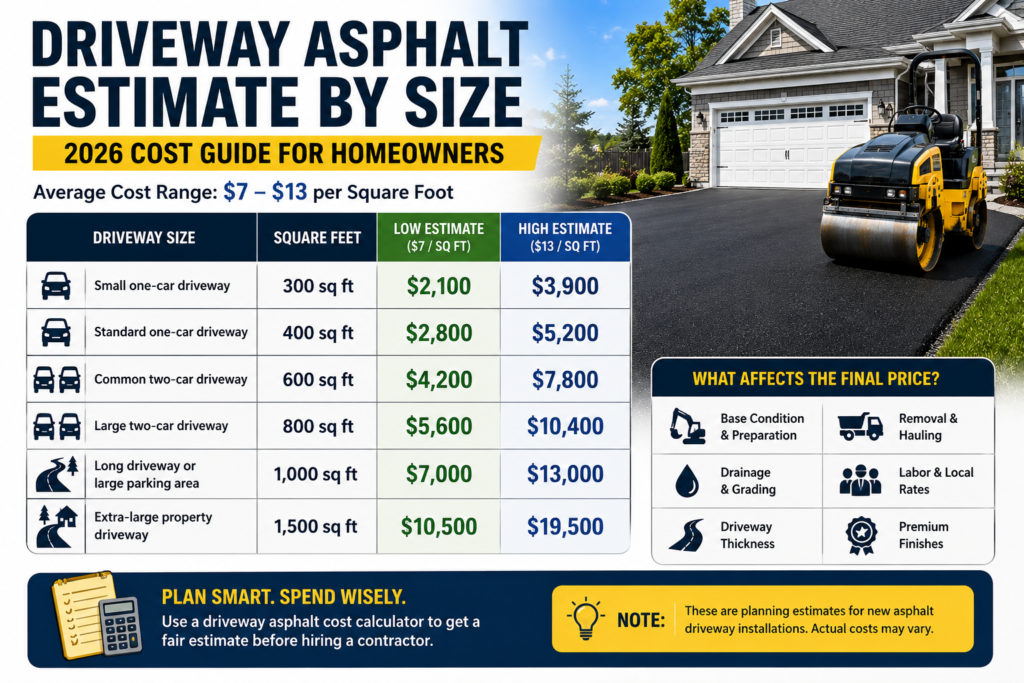
Here is a simple size-based estimate using a $7 to $13 per square foot range for new asphalt driveway work.
| Driveway Size | Square Feet | Low Estimate | High Estimate |
| Small one-car driveway | 300 sq ft | $2,100 | $3,900 |
| Standard one-car driveway | 400 sq ft | $2,800 | $5,200 |
| Common two-car driveway | 600 sq ft | $4,200 | $7,800 |
| Large two-car driveway | 800 sq ft | $5,600 | $10,400 |
| Long driveway or large parking area | 1,000 sq ft | $7,000 | $13,000 |
| Extra-large property driveway | 1,500 sq ft | $10,500 | $19,500 |
These numbers are planning examples. The actual price may be lower for overlay work and higher for full replacement, poor base conditions, drainage work, or premium finishes.
New Asphalt Driveway Cost vs Replacement vs Overlay Cost
New asphalt driveway cost, replacement cost, and overlay cost are not the same. This is one reason a calculator should ask about the project type.
A new asphalt driveway usually means the contractor is building the driveway from the ground up or from a prepared base. This may include grading, stone base, compaction, and asphalt installation.
A replacement project usually costs more because the old surface must be removed first. The contractor may need to break up old asphalt or concrete, haul debris away, rebuild the base, and then install new asphalt.
An overlay is usually cheaper because the contractor adds a new asphalt layer over the existing surface. NerdWallet lists overlay work at about $3 to $7 per square foot. But overlay only makes sense when the current driveway is stable. If the base is weak, cracks may come back through the new layer.
This table shows the basic difference.
| Project Type | What It Means | Cost Level |
| New driveway | Asphalt installed on a prepared base | Medium to high |
| Replacement | Old driveway removed and rebuilt | High |
| Overlay | New asphalt added over existing surface | Lower |
| Resurfacing | Worn top layer renewed | Lower to medium |
A good asphalt driveway replacement cost calculator should separate replacement from overlay because the labor and removal costs are very different.
Cost Examples for Small, Standard, and Large Asphalt Driveways
Cost examples help you see how a calculator estimate works in real life. A small driveway may cost less overall, but it may not always have the lowest cost per square foot because contractors still need equipment, crew time, and delivery.
A standard two-car driveway is often around 600 square feet. Using a $7 to $13 per square foot range, that driveway may cost about $4,200 to $7,800. HomeGuide gives a close example, showing a 600-square-foot two-car asphalt driveway at about $3,000 to $7,200.
A larger 1,000-square-foot driveway may cost about $7,000 to $13,000 before extra work. If the driveway also needs old concrete removal, drainage correction, or more base stone, the price can rise.
Here is a simple cost example table.
| Example | Size | Estimated Cost Range | Best Use |
| Small driveway | 300 sq ft | $2,100 to $3,900 | Short one-car driveway |
| Standard driveway | 600 sq ft | $4,200 to $7,800 | Common two-car driveway |
| Large driveway | 1,000 sq ft | $7,000 to $13,000 | Long driveway or wider parking area |
| Extra-large driveway | 1,500 sq ft | $10,500 to $19,500 | Large home or multi-car access |
After checking these examples, use the asphalt driveway cost calculator to estimate your own driveway price. If you also want to calculate asphalt quantity and cost by tons, use the asphalt calculator tons cost guide before requesting contractor quotes.
Use Our Paving Cost Calculator Before You Request Quotes
Use a paving cost calculator after you understand the basic cost examples. This is the best time because you already know how square footage, project type, and site condition affect the estimate.
A calculator helps you prepare before calling contractors. It also helps you compare quotes after you receive them. If your estimate is around $6,000 and a contractor quotes $10,500, you can ask what extra work is included. If another quote is $3,800, you can ask whether base repair, asphalt thickness, grading, and cleanup are missing.
A good asphalt paving cost calculator should not only show one number. It should give a low and high range because driveway conditions vary. It should also help you think about the difference between new paving, overlay, resurfacing, replacement, repair, and sealing.
Homeowners who search for an asphalt driveway price calculator usually want a quick answer. But the better answer is a fair range with clear cost factors. That helps you avoid both overpriced quotes and risky low bids.
Material and Labor Cost Breakdown
Material and labor make up most of the asphalt driveway price. Angi breaks down a new asphalt driveway into about $2 to $6 per square foot for materials and $5 to $7 per square foot for labor.
Material cost includes the asphalt mix and sometimes the base material. Labor cost includes the crew, equipment use, grading, spreading, compacting, finishing, and cleanup. Asphalt work needs heavy machines, hot material, timing, and skill, so labor is a large part of the final price.
Many homeowners focus only on the asphalt surface. But the base layer is just as valuable. A driveway with poor base preparation may crack or sink even if the top layer looks smooth at first.
A clear quote should show what the contractor is charging for materials, labor, base preparation, removal, and any add-ons. If a quote does not separate these items, ask for more detail before signing.
Asphalt Thickness and Base Layer Costs
Asphalt thickness can change the price and lifespan of the driveway. A thin asphalt layer costs less, but it may not hold up well under heavier vehicles or weak soil conditions.
A residential driveway for regular cars may not need the same thickness as a driveway used by trucks, trailers, RVs, or work vehicles. Heavier use needs stronger planning. That may mean more asphalt, a better base, and better compaction.
The base layer sits under the asphalt. It often includes crushed stone or gravel that is graded and compacted. If the base is soft, uneven, or poorly drained, the driveway can fail early. This is why some contractors spend more time preparing the base than installing the top layer.
Ask the contractor how thick the asphalt will be after compaction. Also ask what base material will be used, how deep the base will be, and how water will be moved away from the driveway.
A calculator can estimate surface cost, but the base layer often explains why two quotes are not the same.
Old Driveway Removal, Excavation, and Grading Costs
Old driveway removal can add a lot to the final price. If the existing surface is cracked, broken, sinking, or made of concrete, the contractor may need to remove it before installing new asphalt.
Removal work may include breaking the old surface, loading debris, hauling material, paying disposal fees, and rebuilding the base. Concrete removal may cost more than old asphalt removal because it can be harder to break and haul.
Excavation and grading also affect the price. The driveway must be shaped so water runs away from the garage, house, and foundation. If the driveway is too flat or sloped the wrong way, water can sit on the surface or flow toward the home.
HomeAdvisor lists drainage systems, custom designs, premium materials, and other features as factors that can raise driveway paving costs. It also reports asphalt driveways at about $7 to $15 per square foot.
If a contractor’s’s quote is higher than your calculator result, removal, excavation, and grading may be the reason. Ask for those items in writing.
Driveway Shape, Slope, and Access Cost Factors
A simple rectangular driveway is usually easier and cheaper to pave than a curved or sloped driveway. Shape affects how much labor is needed and how easy it is to use paving equipment.
Slope matters because water must move the right way. A driveway with a steep incline may need more grading, better compaction, and stronger drainage planning. NerdWallet notes that driveway pitch can affect asphalt driveway cost because an incline can cost more than a flat surface.
Access also changes the price. If large paving equipment cannot reach the area easily, the contractor may need smaller machines or more hand labor. Tight spaces, fences, trees, walls, and narrow entrances can all slow the job.
Driveway shape can also affect material waste. Curves, flared entrances, parking pads, and odd edges may need more cutting and finishing. The price can still be fair, but it should be explained in the quote.
Drainage, Permits, and Site Preparation Costs
Drainage is one of the biggest long-term issues in asphalt driveway work. Water can damage the base layer, create soft spots, and lead to cracking or sinking. A cheap driveway with poor drainage may become expensive after a few seasons.
Good site preparation may include clearing, excavation, stone base, grading, compaction, and water-flow planning. Some driveways also need drains, culverts, or edge support. These items can increase the upfront cost, but they help protect the driveway.
Permits may also affect the price. Some U.S. cities, counties, and HOAs have rules for driveway width, apron work, stormwater flow, sidewalk crossings, and road connections. Permits need to vary by location.
A calculator may not know every local permit rule. That is why your online estimate should be treated as a planning range. The contractor or local office can confirm permit needs.
Asphalt Types That Change Your Final Price
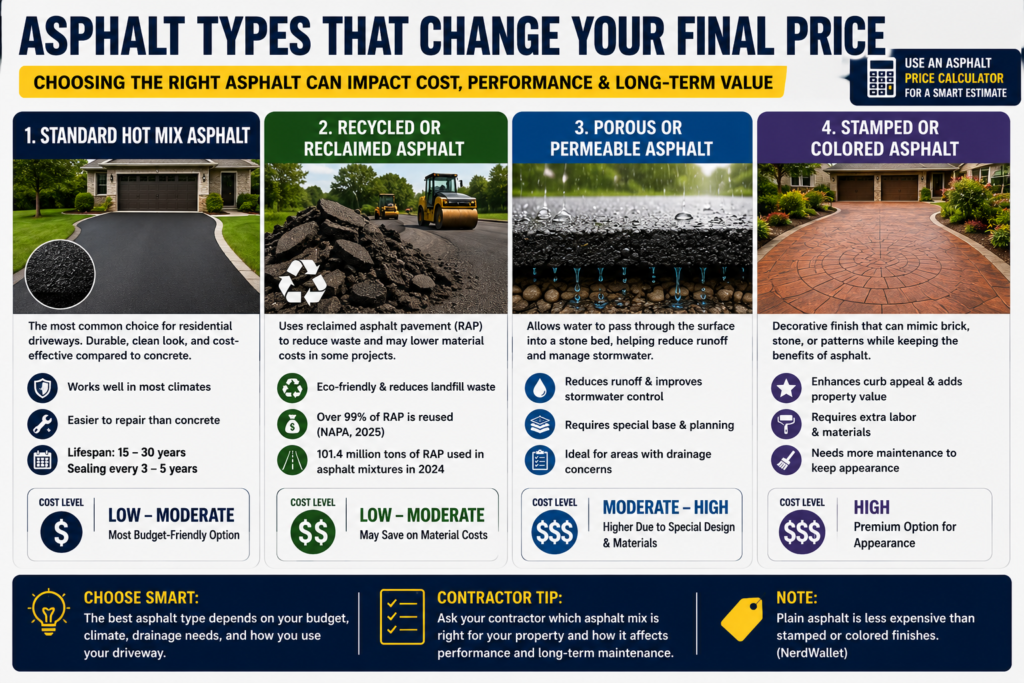
The type of asphalt used can change the final price. Standard hot mix asphalt is the most common choice for residential driveways, but other options may fit certain homes better.
Some homeowners want recycled asphalt because it may lower material waste. Others want porous asphalt to help with water drainage. Some want stamped or colored asphalt for curb appeal.
Each choice affects cost, performance, and maintenance. The best option depends on your budget, climate, drainage needs, and how you use the driveway.
An asphalt price calculator may give a general price range, but your contractor should explain which asphalt mix is right for your property.
Standard Hot Mix Asphalt
Standard hot mix asphalt is the usual choice for many U.S. driveways. It gives a clean black surface, works well in many climates, and is often cheaper upfront than concrete.
This type of asphalt is practical for homeowners who want a simple driveway without decorative finishes. It can also be repaired more easily than concrete in many cases.
HomeGuide reports that blacktop driveways may last about 15 to 30 years and usually need sealing every 3 to 5 years. Lifespan depends on base quality, weather, traffic, drainage, and maintenance.
Standard asphalt is a good choice when the site is prepared well and the homeowner is ready to handle normal upkeep.
Recycled or Reclaimed Asphalt
Recycled or reclaimed asphalt uses old asphalt pavement that has been removed, crushed, and reused. The Federal Highway Administration explains that reclaimed asphalt pavement is removed or reprocessed pavement material that contains asphalt and aggregates.
Recycled asphalt can reduce waste and may lower material costs in some projects. The asphalt industry also uses a large amount of reclaimed material. A 2025 TRB record on the NAPA industry survey reported that more than 99% of reclaimed asphalt pavement is put back to use, and 101.4 million tons of RAP were used in asphalt mixtures in 2024.
Recycled asphalt may work well for long driveways, rural driveways, base layers, and some budget-focused projects. But quality depends on the mix and the contractor’s process.
Ask the contractor whether recycled asphalt will be used in the surface layer, the base, or both.
Porous or Permeable Asphalt
Porous or permeable asphalt allows water to pass through the surface into a prepared stone bed below. It can help reduce runoff and improve stormwater control when it is designed the right way.
NAPA says porous asphalt pavements can help conserve water, reduce runoff, and promote infiltration. That makes this option useful in some areas with drainage concerns.
Porous asphalt usually needs special base planning. It is not just a surface choice. The stone bed, soil, water flow, and maintenance plan all matter.
This option may cost more than standard asphalt, but it may solve a drainage need that a regular driveway cannot handle as well.
Stamped or Colored Asphalt
Stamped or colored asphalt is used when a homeowner wants a more decorative look. It can mimic brick, stone, or patterned paving while keeping some of the benefits of asphalt.
This option usually costs more than plain asphalt because it needs extra labor, finish work, and materials. It may also need more care to keep the appearance clean over time.
Stamped or colored asphalt can make sense for front-facing driveways, custom homes, or properties where curb appeal is a main goal. For a budget driveway, plain asphalt is usually the better fit.
NerdWallet notes that plain asphalt is less expensive than dyed or stamped finishes. That is why decorative finishes should be chosen for appearance, not savings.
Regional Cost Differences and Best Season to Pave
Asphalt driveway cost changes by region. Labor rates, asphalt plant distance, fuel prices, weather, demand, and local permit rules can all affect the final price.
A driveway in Boston may not cost the same as a driveway in Atlanta, Chicago, Phoenix, or rural Ohio. Even two towns in the same state may have different pricing if material delivery or contractor demand is different.
Season also matters. Asphalt is easier to install when the weather is warm enough for proper handling and compaction. Cold weather can make the material cool too quickly. Very wet weather can also delay the job.
Many paving companies are busiest in spring, summer, and early fall. If you wait until the busiest period, you may have fewer scheduling options. Planning early can help you get better availability and more time to compare quotes.
Asphalt vs Concrete vs Gravel Driveway Cost
Asphalt, concrete, and gravel are the three driveway options many U.S. homeowners compare. Each has a different price, look, and maintenance pattern.
Asphalt is often chosen because it has a lower upfront cost than many concrete projects and gives a smooth black surface. Concrete usually costs more in many markets, but it can last longer and needs less frequent sealing. Gravel is often the cheapest upfront option, but it may need more raking, weed control, and surface refreshes.
Angi reports asphalt prices around $7 to $15 per square foot, while concrete can range from $3 to $18 per square foot depending on the project. HomeGuide compares asphalt at about $5 to $12 per square foot and concrete at about $6 to $15 per square foot.
Here is a simple comparison.
| Driveway Material | Typical Cost Level | Main Benefit | Main Tradeoff |
| Asphalt | Medium | Lower upfront cost and easier repairs | Needs sealing and maintenance |
| Concrete | Medium to high | Longer lifespan and clean look | Higher upfront cost in many areas |
| Gravel | Low | Cheapest upfront choice | More upkeep and less finished look |
Asphalt is a strong choice when you want a practical driveway with a fair upfront price. Concrete may be better when long life and low maintenance matter more than the first cost. Gravel may work best for long rural driveways or low-budget access roads.
Hidden Costs That Make Homeowners Overpay
Homeowners often overpay because they compare final prices without checking the scope. One quote may include base repair, grading, and cleanup. Another may only include a thin asphalt layer. Both prices may look simple, but the value is not the same.
Hidden costs can include old driveway removal, extra base stone, grading, drainage repair, permit fees, hauling, thick asphalt upgrades, tree root removal, edge support, sealing, and minimum job charges.
Some of these costs are fair. The issue is when they appear after the homeowner has already agreed to a low estimate. That can make the final bill much higher than expected.
An asphalt driveway repair cost calculator can help with patching and repair planning, but deep cracks or sinking areas may show that the base has failed. In that case, repair may not be enough.
To avoid overpaying, ask for a written quote that explains what is included. If a contractor does not want to write the details, be careful.
How to Get an Accurate Driveway Asphalt Estimate From Contractors
To get an accurate driveway asphalt estimate, give each contractor the same information. Share your driveway size, photos, current surface condition, drainage concerns, project type, and whether you want new paving, overlay, repair, sealing, or replacement.
Ask each contractor to measure the driveway and explain the square footage. Then ask what asphalt thickness they recommend and why. Also ask whether the quote includes base preparation, grading, removal, hauling, and cleanup.
The quote should explain the work in plain language. You should be able to see what you are paying for. If one contractor includes removal and another does not, you cannot compare those prices fairly.
You can also ask about the timeline, weather delays, warranty, and maintenance after installation. A good contractor should be willing to explain the work clearly.
A calculator gives the starting range. A detailed contractor quote gives the project price.
Smart Ways to Save Money Without Choosing Cheap Work
You can save money on asphalt paving without choosing weak work. The goal is to remove waste, not cut the parts that protect the driveway.
A simple driveway shape can cost less than a decorative or complex layout. Planning early can give you more time to compare quotes. Using an overlay can save money if the base is still solid. Recycled asphalt may lower the cost in some cases. Avoiding stamped or colored finishes can also keep the project more affordable.
But some parts should not be skipped. Base preparation, grading, drainage, and proper compaction protect the driveway. Cutting these items may lower the first quote but raise future repair costs.
An asphalt driveway resurfacing cost calculator can help you compare resurfacing with full replacement. If the surface is worn but the base is strong, resurfacing may be a smart choice. If the base is failing, replacement may be the better long-term move.
For sealing work, people often search for an asphalt driveway sealing cost calculator near me because prices can vary by local labor and driveway size. Sealing costs less than paving, but it is maintenance, not a fix for serious structural damage.
Is an Asphalt Driveway Worth It in 2026?
An asphalt driveway can be worth it in 2026 for homeowners who want a practical surface, a fair upfront cost, and faster installation than many concrete projects. It is also easier to repair in many cases.
Asphalt works well for many U.S. homes, especially in areas with freezing weather, because it has some flexibility. It can still crack if the base is poor, water sits on the surface, or maintenance is ignored.
HomeGuide reports that blacktop can last about 15 to 30 years with proper care and sealing every 3 to 5 years. That makes maintenance part of the real cost, not an optional thought after installation.
If you want a clean, durable driveway at a fair upfront price, asphalt is a strong option. If you want the longest possible lifespan with less frequent sealing, concrete may be worth comparing.
The best choice depends on your budget, climate, driveway use, and how long you plan to stay in the home.
Try our Asphalt Tonnage Calculator guide to know the asphalt quantity using a proven and accurate formula.
Frequently Asked Questions (FAQs)
How accurate is an asphalt driveway cost calculator?
An asphalt driveway cost calculator gives a planning estimate, not a final quote. It can be useful when you enter the right driveway size, project type, and basic condition. The final price may change after a contractor checks the slope, base layer, drainage, access, and old surface.
A calculator is most helpful before you call contractors and after you receive quotes. It helps you see whether a quote is close to the normal range or needs more explanation.
What is the average asphalt driveway cost in 2026?
The average asphalt driveway cost in 2026 often falls around $5 to $15 per square foot, depending on project type and source. Angi lists new asphalt driveway installation at about $7 to $13 per square foot. HomeGuide lists asphalt paving around $5 to $12+ per square foot.
Your price may be lower for a simple overlay and higher for replacement, drainage work, poor base conditions, or a premium finish.
How much does a 600-square-foot asphalt driveway cost?
A 600-square-foot asphalt driveway may cost about $4,200 to $7,800 using a $7 to $13 per square foot range. HomeGuide gives a close real-world range of about $3,000 to $7,200 for a 600-square-foot two-car asphalt driveway.
The price depends on local labor, asphalt thickness, base work, removal, grading, and drainage.
Is asphalt cheaper than concrete?
Asphalt is often cheaper upfront than concrete in many U.S. markets. HomeGuide lists asphalt at about $5 to $12 per square foot and concrete at about $6 to $15 per square foot. Angi shows asphalt around $7 to $15 per square foot, while concrete can range from $3 to $18 per square foot depending on the project.
Concrete may last longer in some cases, but asphalt can be easier and cheaper to repair. The better choice depends on budget, climate, and maintenance plans.
How much does asphalt overlay cost?
Asphalt overlay often costs about $3 to $7 per square foot, based on NerdWallet’s driveway cost data. Overlay is cheaper than full replacement because the old surface stays in place.
Overlay is not always the right choice. If the driveway has deep cracks, sinking spots, poor drainage, or a weak base, the new layer may fail early.
What increases the asphalt driveway cost the most?
The biggest cost drivers are driveway size, old pavement removal, base repair, grading, drainage, asphalt thickness, local labor rates, and access problems. A large flat driveway with a good base may be easier to price. A smaller driveway with concrete removal, poor drainage, and limited access may cost more than expected.
This is why an asphalt parking lot cost calculator is different from a driveway calculator. Parking lots often involve striping, curbing, drainage, traffic load, and larger material planning. A residential driveway estimate is usually simpler.
Can I reduce the asphalt driveway cost?
Yes, you can reduce the cost by keeping the design simple, comparing multiple written quotes, avoiding decorative finishes, and choosing resurfacing only when the base is still strong.
You should not save money by skipping grading, compaction, drainage, or base repair. Those shortcuts can lead to cracks, dips, and costly repairs later.
An asphalt driveway sealing cost calculator near me can help plan maintenance costs after paving, but sealing will not fix a weak base.
When should I use a paving cost calculator?
Use a paving cost calculator before you request quotes. It gives you a fair starting range and helps you understand what contractors may charge.
Use it again after you receive quotes. If one quote is much higher or lower than the calculator estimate, ask what is included. A clear contractor should explain the difference in plain language.