
Planning an asphalt project starts with one simple question: how much asphalt do you need? An asphalt volume calculator helps answer that by turning your project measurements into cubic yards, tons, and coverage estimates. This guide explains how asphalt volume works, how to convert square feet and square yards into tons, how thickness changes the final amount, and how to avoid ordering too much or too little material.
You can use this guide along with an asphalt calculator when you want faster numbers for a driveway, parking area, road patch, walkway, or resurfacing job. The goal is simple: help you understand the math before you order asphalt.
What is the Asphalt Volume Calculator?
An asphalt volume calculator is a simple tool that estimates how much asphalt is needed for a paving project. It usually asks for length, width, and thickness. After that, it converts the measurements into volume and weight.
Most homeowners measure their project in square feet. Asphalt suppliers usually sell asphalt by the ton. That is why a calculator is useful. It connects the measurements you know with the unit your supplier uses.
For example, a driveway may be measured as 600 square feet. But your supplier may ask how many tons of asphalt you need. An asphalt calculator that converts square feet to tons helps bridge that gap.
The calculator is useful for home driveways, small road repairs, parking lots, private lanes, asphalt pads, commercial paving areas, and resurfacing work.
It also helps reduce waste. Ordering too little asphalt can stop the job before it is finished. Ordering too much can increase cost and leave unused material.
In the United States, asphalt is one of the most reused paving materials. The National Asphalt Pavement Association reported that more than 99% of reclaimed asphalt pavement is put back to use, and 96.1 million tons of RAP were used in asphalt mixtures in 2023. That shows how large the asphalt industry is and why accurate estimating matters for both cost and material planning.
How Does Asphalt Volume Calculation Work?
Before using any calculator, you need to know the difference between area, volume, and weight. Area tells you how much surface you will cover. Volume adds depth or thickness to that surface. Weight tells you how much asphalt must be ordered.
This is where many people get confused. A driveway may look flat, but asphalt has depth. A 2-inch asphalt layer needs less material than a 4-inch layer on the same surface.
The basic idea is simple:
Area × Thickness = Volume
Then:
Volume × Asphalt Density = Weight
Most asphalt jobs in the United States use tons for ordering. So, after finding the volume, the next step is converting that volume into tons.
If you want a deeper cost view after finding the amount, you can compare your estimate with this asphalt tons and cost calculator guide. It helps connect material quantity with budget planning.
Asphalt Calculator Square Feet to Tons — Step-by-Step
An asphalt calculator square feet to tons is helpful when your project area is measured in square feet. This is common for driveways, small parking pads, and residential paving jobs.
To calculate asphalt from square feet to tons, you need three numbers: total square feet, asphalt thickness, and asphalt density.
The standard formula is:
Square Feet × Thickness in Feet × Density ÷ 2,000 = Tons
The number 2,000 is used because one U.S. short ton equals 2,000 pounds.
Here is a simple example.
A driveway is 30 feet long and 20 feet wide. The asphalt thickness is 3 inches.
First, find the area:
30 × 20 = 600 square feet
Then convert thickness into feet:
3 inches ÷ 12 = 0.25 feet
Now calculate the volume:
600 × 0.25 = 150 cubic feet
If we use 145 pounds per cubic foot as a common asphalt density estimate:
150 × 145 = 21,750 pounds
Now convert pounds into tons:
21,750 ÷ 2,000 = 10.875 tons
So this driveway needs about 10.9 tons of asphalt before adding waste or extra material.
This is why an asphalt calculator square feet or an asphalt calculator by square feet is helpful. It saves time and lowers the chance of math errors.
| Step | Calculation | Result |
| Area | 30 ft × 20 ft | 600 sq ft |
| Thickness | 3 in ÷ 12 | 0.25 ft |
| Volume | 600 × 0.25 | 150 cu ft |
| Weight | 150 × 145 | 21,750 lb |
| Tons | 21,750 ÷ 2,000 | 10.875 tons |
Asphalt Square Yards to Tons Calculator Explained
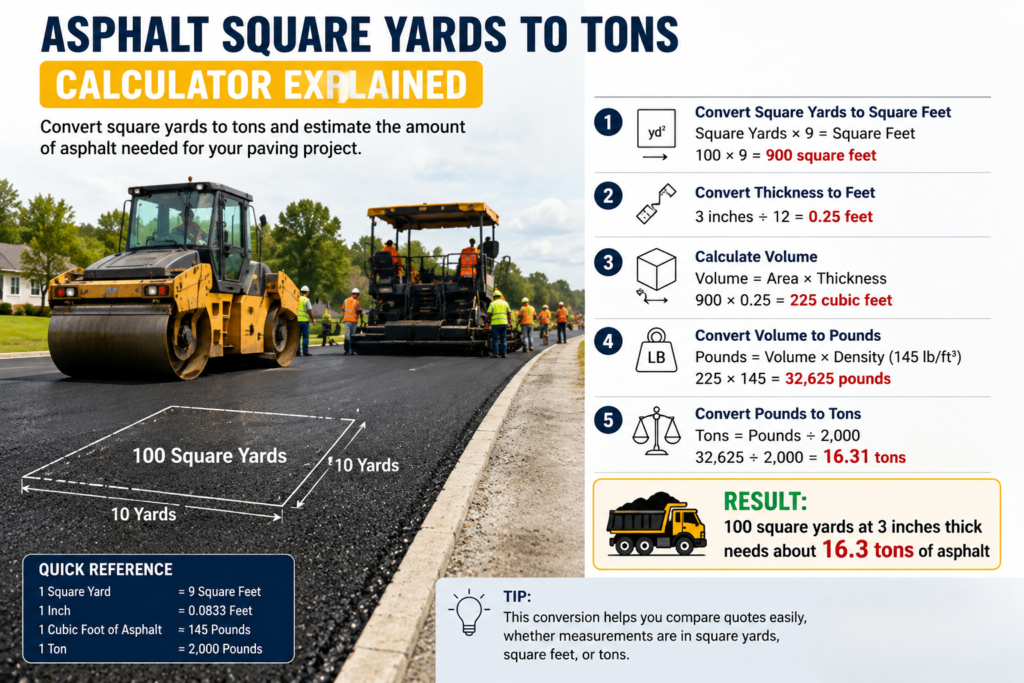
An asphalt square yards to tons calculator is useful when a contractor, plan, or bid sheet uses square yards instead of square feet. This is common in larger paving jobs.
One square yard equals 9 square feet. So if you already know the square yards, you can convert them into square feet first.
The formula is:
Square Yards × 9 = Square Feet
After that, you can use the same tons formula.
For example, say a project area is 100 square yards, and the asphalt thickness is 3 inches.
First, convert square yards into square feet:
100 × 9 = 900 square feet
Then convert 3 inches into feet:
3 ÷ 12 = 0.25 feet
Now calculate the volume:
900 × 0.25 = 225 cubic feet
Now convert volume into pounds:
225 × 145 = 32,625 pounds
Now convert pounds into tons:
32,625 ÷ 2,000 = 16.31 tons
So 100 square yards at 3 inches thick needs about 16.3 tons of asphalt before adding waste.
This type of conversion is useful when comparing quotes. One contractor may describe the job in square yards, while another may use square feet or tons. A calculator helps you compare the numbers more clearly.
Asphalt Tonnage Calculator Basics
An asphalt tonnage calculator focuses on the final weight of asphalt. This is the number most suppliers and paving contractors care about because asphalt is usually ordered by the ton.
An asphalt tons calculator, asphalt ton calculator, or asphalt calculator tons all work in a similar way. They estimate the final tons based on area, thickness, and density.
The main factor that changes tonnage is thickness. If you double the thickness, you almost double the asphalt needed.
For example, a 1,000 square foot area at 2 inches thick needs much less asphalt than the same area at 4 inches thick. The surface area did not change, but the volume changed.
This is why tonnage and thickness should be planned together. You can also use this guide on how to calculate asphalt tonnage when you want a closer look at the tonnage process.
A good tonnage estimate helps with: Ordering material, planning truckloads, checking contractor estimates, reducing waste, and building a more accurate budget.
Unit Conversion Tables (Quick Reference)
Asphalt estimating often requires unit conversion. You may start with square feet, then need cubic feet, cubic yards, pounds, and tons.
The table below gives quick reference numbers that are useful for asphalt volume work.
| Conversion | Value |
| 1 square yard | 9 square feet |
| 1 cubic yard | 27 cubic feet |
| 1 U.S. short ton | 2,000 pounds |
| Common asphalt density estimate | About 145 lb per cubic foot |
| 1 cubic yard of asphalt | About 1.95 tons at 145 lb/cu ft |
These numbers are estimates. Asphalt mix type, compaction, moisture, aggregate size, and supplier standards can change the final weight.
Still, this table helps when using an asphalt weight calculator or an asphalt yield calculator. It gives you a quick way to understand what the calculator is doing behind the scenes.
For a simple rule, one cubic yard of asphalt is often close to 2 tons. But for ordering material, always check the density or yield value from your supplier.
Tools & Calculators You Can Use (Examples)
A calculator is the fastest way to reduce guesswork. You can use an asphalt volume calculator when you already know the length, width, and thickness of your project.
For example, if your driveway is 40 feet long, 18 feet wide, and 3 inches thick, you can enter those numbers into a calculator and get a quick estimate in cubic yards and tons.
This is also the best place to use your tool link because the reader is ready to calculate. Use the asphalt volume calculator to check your own project size and compare the result with the formulas in this guide.
A good calculator should let you enter: Length, width, thickness, unit type, density, and waste percentage.
Some calculators also show cost estimates. That can help when you are planning a driveway or asking for paving quotes.
If your calculator only gives volume, you may still need to convert cubic yards into tons. If it gives tons, check what density it uses before relying on the number.
Common Mistakes with Asphalt Volume Estimates
A small mistake in asphalt estimating can change the final order by several tons. That can raise your cost or delay the job.
One common mistake is using inches as feet. For example, 3 inches is not 3 feet. It must be converted to 0.25 feet before using the formula.
Another mistake is ignoring thickness. Many people only measure length and width. But asphalt depth is what turns surface area into volume.
Some people also forget waste. Asphalt jobs are not always perfect rectangles. Edges, curves, grading, and compaction can change the final amount. Many contractors add a small extra amount to reduce shortage risk.
Density is another common issue. Different asphalt mixes can weigh slightly different amounts. A common estimate is around 145 pounds per cubic foot, but your local supplier may use a different number.
A final mistake is using the wrong calculator for the job. An asphalt square footage calculator helps with area. An asphalt tonnage calculator helps with ordering weight. A full asphalt volume calculator connects both.
Recommended Thickness & Coverage Guidelines
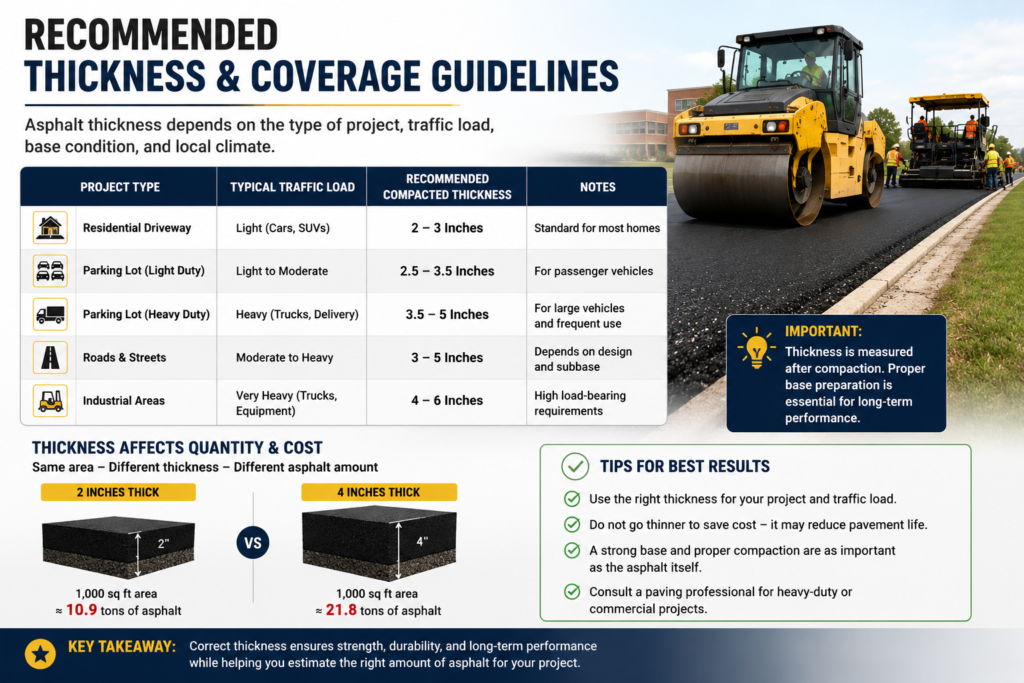
Asphalt thickness depends on the type of project, base condition, traffic load, and local climate. A light residential driveway does not need the same thickness as a commercial lot with delivery trucks.
In many residential driveways in the United States, asphalt is typically placed to a thickness of 2 to 3 inches after compaction. Heavier-use areas may need more depth.
Parking lots often need thicker asphalt than small driveways. Areas with trucks, buses, or heavy equipment may need stronger pavement design and a better base.
Thickness also affects cost. If the area stays the same but the asphalt thickness increases, the amount of asphalt increases as well.
For example, a 1,000 square foot area at 2 inches thick uses about half the asphalt of the same area at 4 inches thick, assuming the same density.
If you are planning a home driveway, this asphalt driveway thickness guide can help you understand how depth affects strength, cost, and long-term performance.
Cost Estimation & Budgeting Tips
Once you know the tons, you can start estimating the project cost. Asphalt cost depends on location, oil prices, labor, equipment, base preparation, haul distance, and project size.
Small residential jobs often cost more per ton than large commercial jobs because setup, labor, and equipment movement are spread across fewer tons.
This is why an asphalt calculator formula is useful before calling contractors. It gives you a rough material amount, so you can compare quotes with more confidence.
For example, if your estimate shows the job needs about 12 tons, and a quote appears to price the job as if it needs 20 tons, you can ask for a breakdown.
A calculator will not replace a contractor’s site visit, but it can help you ask better questions.
For driveway budgeting, you can also review this asphalt driveway cost calculator to compare size, thickness, and estimated cost in one place.
Best Practices Before You Order Asphalt
Before ordering asphalt, measure the area carefully. Do not guess the length and width. A small mistake across a large area can change the final tonnage.
Check the planned thickness. Ask whether the thickness is before or after compaction. This matters because compacted asphalt is the final installed layer.
Talk to your supplier or contractor about density. If they use a specific density for your mix, use that number instead of a general estimate.
Also check the base. A weak base can cause cracks, dips, and early pavement failure. Asphalt performs better when the base is compacted, stable, and properly graded.
Drainage matters too. Water should move away from the paved area. Standing water can shorten pavement life and cause surface damage.
If the project has curves, uneven edges, slopes, or patch areas, add a reasonable waste factor. This gives the crew enough material to finish the job without stopping short.
Frequently Asked Questions (FAQs)
How do I use an asphalt volume calculator for my driveway or parking lot?
To use an asphalt volume calculator, measure the length, width, and thickness of your project. Enter these numbers into the calculator. It will estimate the total asphalt volume in cubic feet or cubic yards and convert it into tons. If the tool allows, enter the asphalt density provided by your supplier for the most accurate estimate. Using this helps you order the right amount and avoid running out mid‑project.
How do I convert my project’s square feet into tons using an asphalt calculator square feet to tons?
First, multiply the total square feet by the asphalt thickness in feet. Next, multiply that volume by the asphalt density in pounds per cubic foot. Finally, divide by 2,000 to convert pounds into U.S. tons. This quick calculation prevents mistakes and gives a reliable estimate before contacting suppliers or contractors.
How many tons are in one cubic yard of asphalt?
One cubic yard equals 27 cubic feet. With standard asphalt weighing about 145 pounds per cubic foot, one cubic yard weighs roughly 3,915 pounds. Dividing by 2,000 gives about 1.96 tons per cubic yard. Exact weight can vary slightly depending on mix type and compaction.
What is the difference between an asphalt weight calculator and an asphalt yield calculator?
An asphalt weight calculator estimates the total weight in tons or pounds, which is useful for ordering asphalt. An asphalt yield calculator estimates how much area that asphalt will cover at a specific thickness, helping plan coverage and layout. Both calculators are helpful, but they serve different purposes.
Should I use an asphalt square yards to tons calculator or stick to square feet?
It depends on how your project is measured. If your plan, bid, or contractor quote lists square yards, use an asphalt square yards to tons calculator. If you measured your project in feet, use an asphalt calculator by the square foot. Either method works as long as you convert the units correctly.
How much extra asphalt should I order for waste and compaction?
Most paving projects need about 5–10% extra asphalt for edge shaping, compaction, and irregular areas. Simple square or rectangular driveways may need only a small buffer, while curved or patchy areas may require more. Check with your contractor or supplier before ordering.
Can I use an asphalt tonnage calculator for both small and large projects?
Yes, an asphalt tonnage calculator works for projects of any size. It calculates tons based on area, thickness, and density. Large commercial jobs or small residential driveways can all benefit from accurate tonnage estimates, reducing over-ordering or under-ordering.
How does thickness affect asphalt calculations in an asphalt volume calculator?
Thickness has a direct impact on volume and weight. Doubling the thickness of your asphalt layer nearly doubles the amount needed. That’s why specifying the correct thickness in inches (converted to feet for calculation) is essential for accuracy.
Is it better to estimate using an asphalt calculator, tons, or volume in cubic yards first?
Both work. Calculating volume first (cubic yards) helps visualize the material needed for the area. Converting to tons gives you the supplier‑friendly number. Using an asphalt calculator tons skips the manual conversion, making ordering faster and simpler.
Can I rely solely on an asphalt square footage calculator for large commercial projects?
You can start with an asphalt square footage calculator, but large projects often need adjustments for compaction, waste, and varying thickness. Combining the square footage calculation with an asphalt tonnage calculator ensures you order the correct amount and stay on budget.
Conclusion & Next Steps
An asphalt volume calculator helps turn project measurements into real numbers you can use. It connects square feet, square yards, cubic yards, and tons so you can plan your asphalt order with less guesswork.
The main steps are simple. Measure the area, choose the asphalt thickness, convert the thickness into feet, calculate the volume, and convert that volume into tons.
For most projects, the biggest factors are surface area, thickness, density, and waste. Once you understand these, it becomes easier to compare contractor quotes, estimate costs, and plan material needs.
Before ordering, check your measurements, confirm the mix density, and review the base and drainage. A good estimate saves money, but good site prep helps the pavement last longer.